
by Kaitlin Scott
The race for the next UN Secretary-General, which will conclude by the end of this year, has highlighted the outsized role the Security Council plays in selecting the organization’s top official. Under Article 97 of the UN Charter, the General Assembly appoints the Secretary-General (SG), but only “upon the recommendation of the Security Council,” that of which is normally acquiesced by the General Assembly. Because the Security Council still controls the selection process, Council membership constitutes a form of influence over the SG selection process. Yet, fifty-nine UN Member States have never served on the Security Council and have consequently remained excluded from the process.
Although not explicitly codified, secret straw polls solidify the 15-member Council’s control. This informal voting mechanism determines which candidate will be recommended to the General Assembly. Thus far in 2026, the five polls have been blind, with no disclosure over how the veto-wielding permanent members (P5) were voting.
Rebeca Grynspan, former Vice President of Costa Rica and Secretary-General of UN Trade and Development, is currently considered the frontrunner. To be recommended to the General Assembly, an SG candidate must secure nine Security Council votes and avoid a P5 veto. Some reports suggest that the United States, a P5 member, does not approve of any candidates, which raises the possibility of a veto that could destabilize the 2026 selection process. Later this month, the Council will switch to color-coded ballots that distinguish the P5’s votes from those of the Council’s ten elected members (E10), although the polls will remain anonymous.
It is worth considering how much influence the E10 can have on this process and why some states do not pursue an elected seat, given the power of the Security Council in appointing the SG. Conversations about which UN Member States have never served on the Council re-emerged in July 2026, when Kyrgyzstan was elected to the body for the first time. States may face a range of hurdles in running for an E10 seat, from intrastate conflict and geopolitical considerations to resources and material costs.
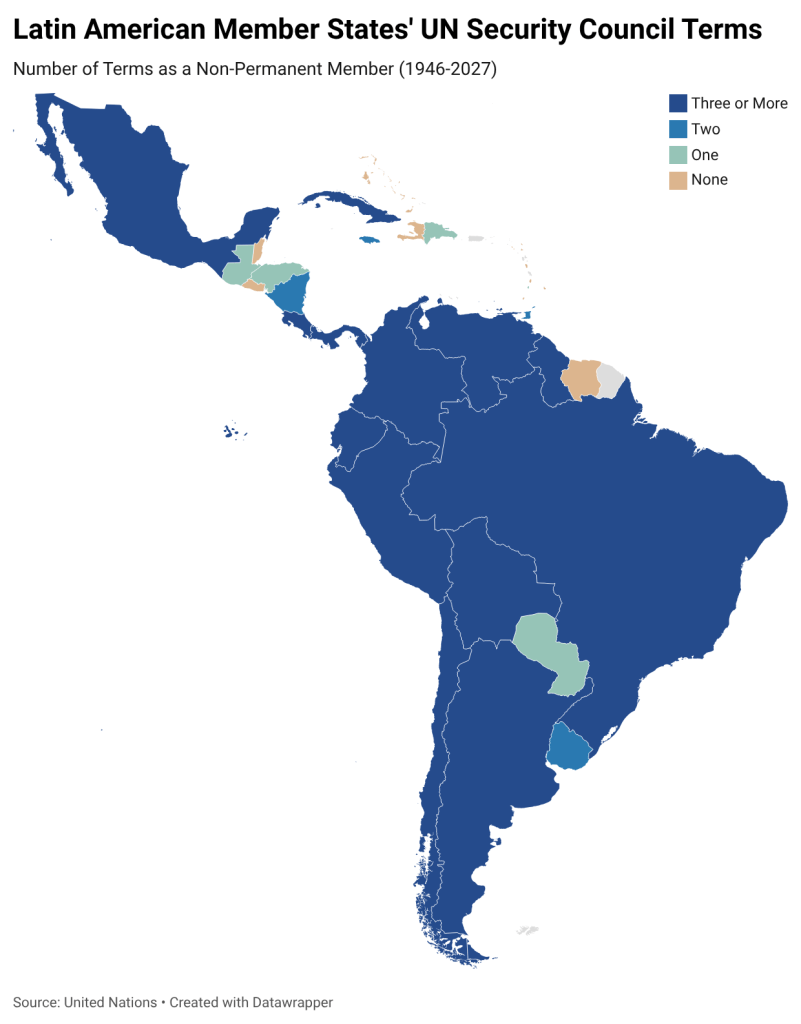
Serving as an E10 member can enhance a state’s prestige and strengthen its international influence, whether through explicit decision-making power over the agenda or strengthening relationships with the P5. The fifty-nine Member States that have never served on the Security Council span all five of the UN’s regional groups.1 Populous countries tend to be elected more frequently. This pattern is visible in Latin America, where the region’s four most populous countries (Brazil, Mexico, Colombia, and Argentina) have each served three or more two-year terms.2
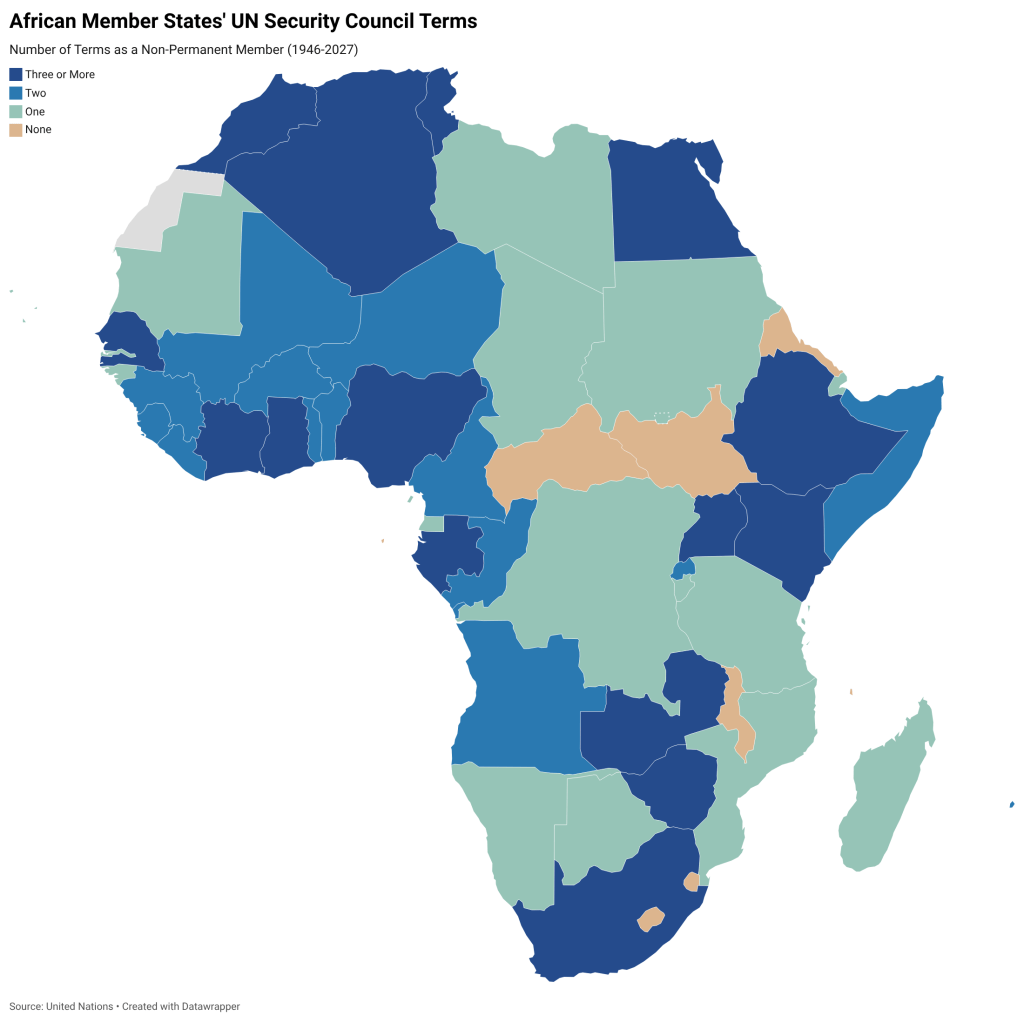
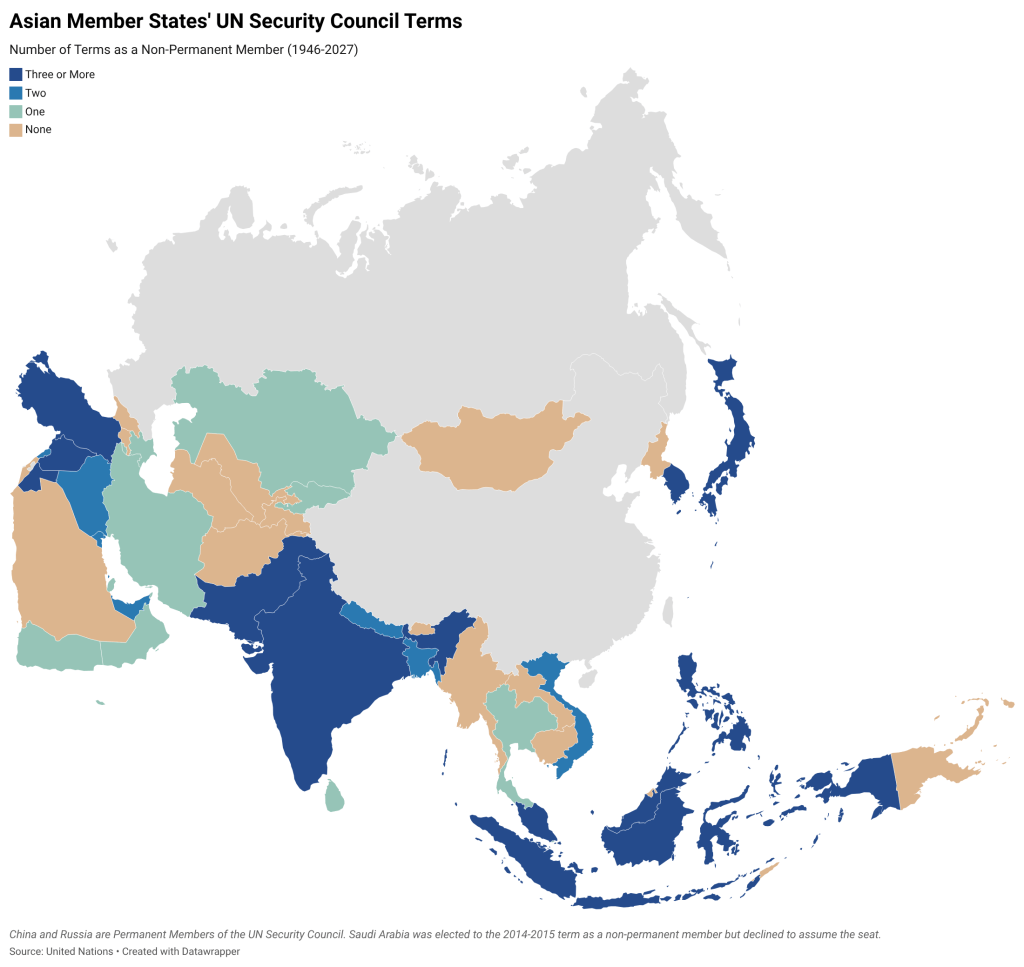
Decolonization after the Second World War transformed the UN’s membership as new nation-states gained independence. Many states in Africa and Asia joined the UN decades after the Security Council’s creation, so they have had fewer opportunities to seek an E10 seat. The UN attempted to respond to its growing membership by expanding the Council from six to ten elected members in 1965, but it maintained the existing P5 structure. Meanwhile, legacies of colonialism have contributed to political challenges, economic inequities, and, in some cases, proxy wars in newly independent states. These conditions matter, given research finds that states with intrastate or protracted conflicts are less likely to be E10 candidates.
Votes in the Council also do not carry equal weight. The P5’s right to veto substantive resolutions, which the E10 lacks, creates a further imbalance. The unequal voting system may hinder perceptions of the influence of the elected members, leading some states to decide against pursuing an E10 seat.
Because the UN Charter gives the Council “primary responsibility for the maintenance of international peace and security,” it routinely debates geopolitically contested situations. Some countries may forgo a run for a seat to avoid taking overt political stances, through a vote on a resolution or statement, on sensitive issues. Such signaling could reveal a misalignment with an otherwise bilateral or strategic ally. When Saudi Arabia won election to the Council in 2013 and then declined the seat, some analysts speculated that the Kingdom preferred to avoid friction with the U.S. and to preserve bilateral defense and economic ties.
Furthermore, the diplomatic and financial capacities required to serve on the Council are considerable. Article 28 of the UN Charter envisions a Council “able to function continuously,” meaning each member must be present and represented at all times. This imposes a high cost of doing business on Member States, particularly given that New York is a high-cost duty station, which affects not only the UN Secretariat but also permanent missions. The costs of campaigning can also be a barrier. For example, the 2026 UNSC elections saw a catered breakfast financed by Austria prior to the General Assembly vote. Hosting such events, and bearing what might be categorized as frivolous expenditures in generating political capital, is not feasible for all governments or diplomatic missions in New York.
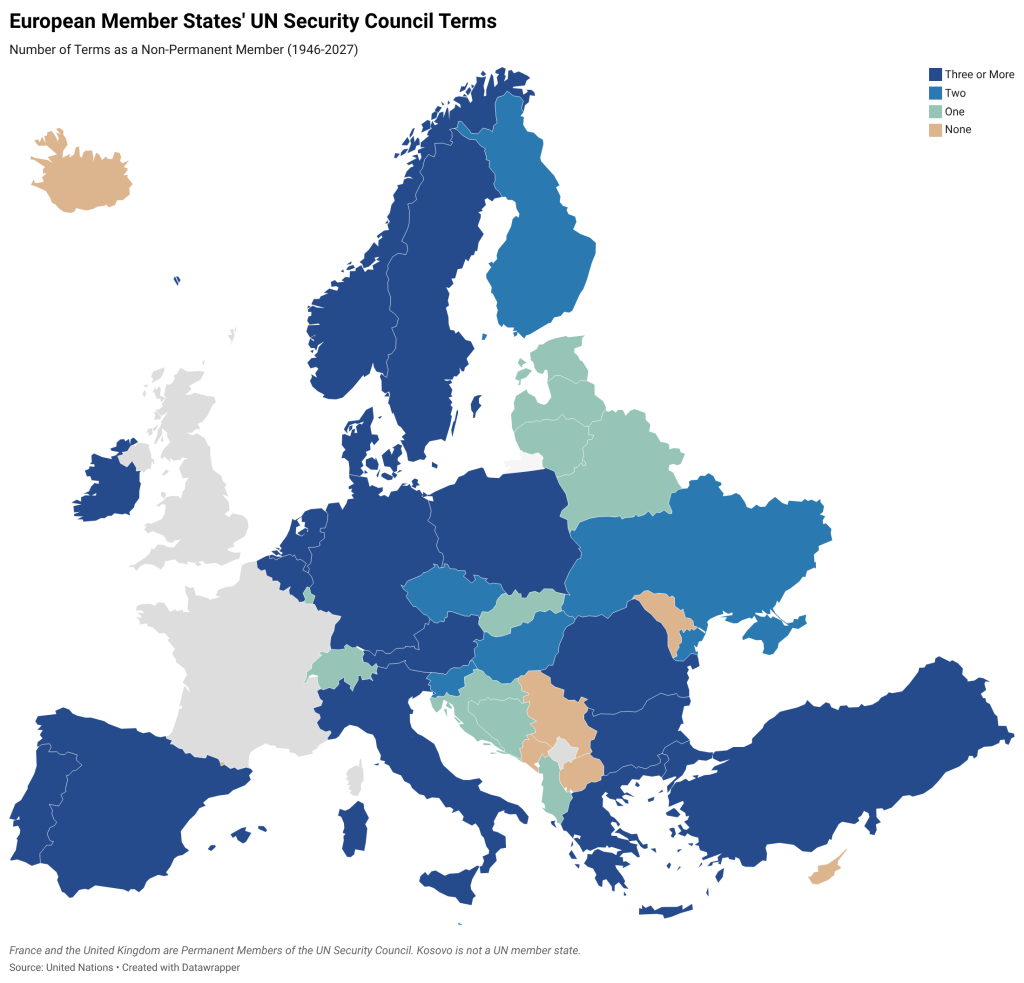
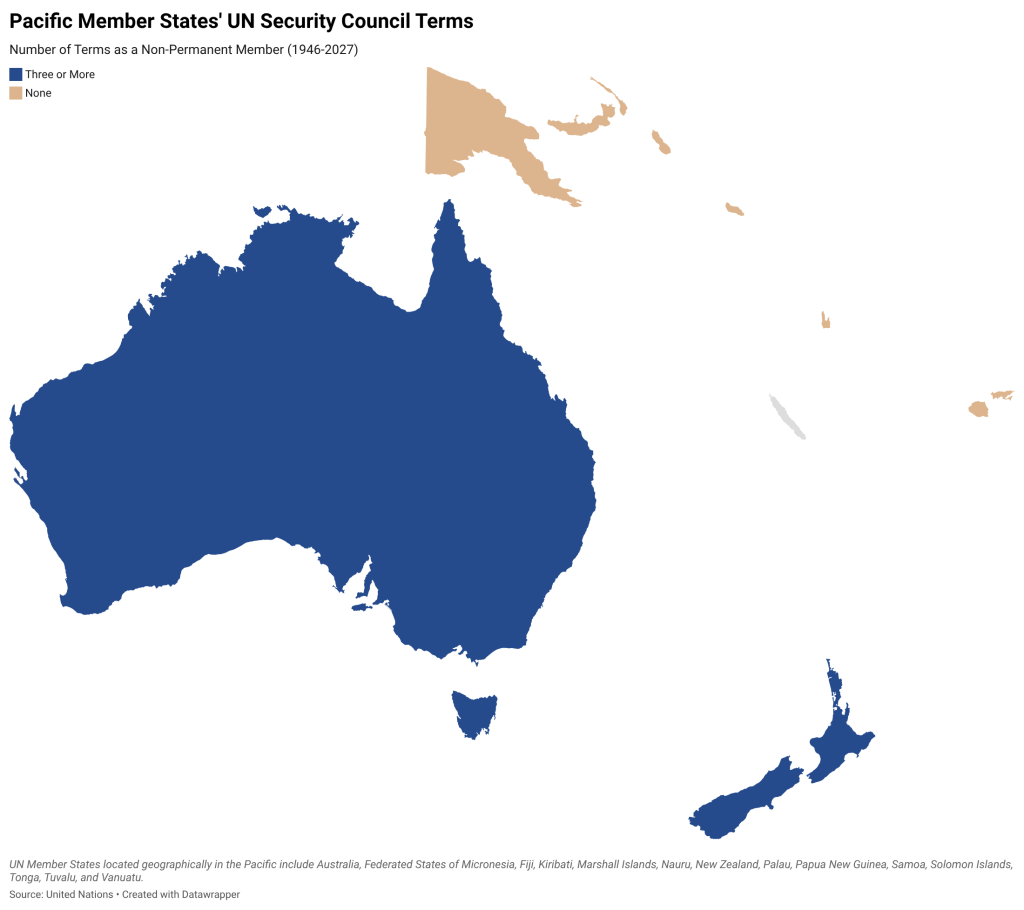
The forthcoming switch to color-coded straw polls will soon reveal more about P5 preferences in selecting the next Secretary-General, but it will reveal nothing about the interests missing from the room. Barriers to E10 seats fall unevenly, and states that have never campaigned have not always stayed out by choice. These are the same states with the least say over the UN’s next leader, which calls the institution’s legitimacy into question and contributes to the perception that the Security Council constitutes an “enduring form of imperialism.” The focus should not only be on how fifteen or five states vote, but who gets to be among them, how often, and what tangible efforts are working to maintain international peace and security.
- Omitted from the United Nations list is Saudi Arabia, which was elected to the Security Council in 2013 but subsequently declined the seat, which was filled by Jordan. ↩︎
- Maps created by the author. Data acquired from the United Nations Peace and Security Data Hub. ↩︎


0 comments on “Straw Polls of Power? The Secretary-General Election and the Exclusion of States Outside the UN Security Council”