
by Jasmin Scherr
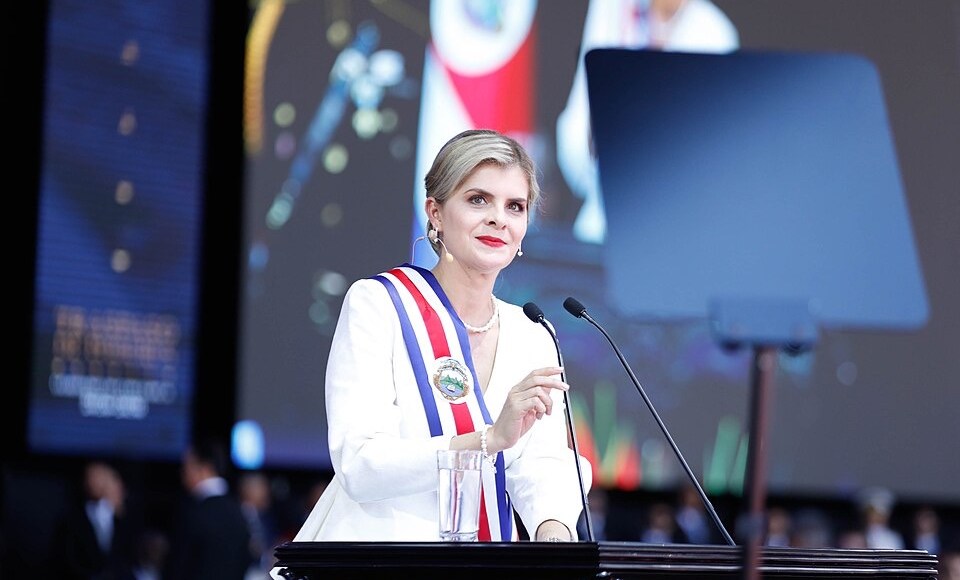
Costa Rica has a new president as of May 2026: Laura Fernández, a member of the right-wing Partido Pueblo Soberano (Sovereign People’s Party). The main focus of her political campaign was fighting narcotrafficking in order to reduce organised crime, which is becoming a growing concern in Costa Rica. Fernández’s programme focuses primarily on continuing the legacy of her predecessor, Rodrigo Chaves, which involves upholding the values of the Sovereign People’s Party: right-wing populism, economic liberalism, and social conservatism. The first couple of months of her presidency have been marked by three political motions: attempts to privatise the electricity sector, plans to build a Bukele-style prison and cuts to university funding. These motions demonstrate that Costa Rica is following a pattern adopted by far-right governments elsewhere in Latin America, such as ultra-neoliberal economic policies, the strengthening of coercive powers and the weakening of civil society.
One of the first moves was an electricity market reform. Since its establishment in 1949, the Institutio Costarricense de Electricidad (Costa Rican Electricity Institute), also called ICE, has been responsible for providing energy and telecommunications services for the population, improving household access to electricity. Its unique structure of municipal enterprises and cooperatives, combined with public management of the service, has proven very successful. Fernández’s electricity harmonisation proposal aimed to establish a wholesale electricity market in which private generators could sell energy to major consumers or export it. The bill, which would have partially opened Costa Rica’s electricity generation market to private investors while keeping ICE’s assets and the state’s control of the grid in public hands, sparked large-scale protests. Last month, the bill failed to pass and was permanently shelved. While the government, ICE and business chambers defended the bill as necessary to meet growing energy demand, unions and opposition legislators called it privatisation by stealth, arguing that it would undermine ICE’s solidarity model.
Additionally, in an attempt to address drug-related crime, organised crime and the high homicide rate, in October 2026, Fernández inaugurated a high-security prison inspired by the Salvadoran model established under Nayib Bukele, who is known for his anti-gang policies. However, the model is mainly criticized for the human rights violations associated with the ‘state of exception‘, which allowed to imprison about 93,000 people in under four years, with some people being detained without charge. The ‘tico‘ prison, which is located just outside the capital, San José, has space for 5,100 inmates and cost an estimated $35 million (USD) to build. Fernández is said to be committed to making Costa Rica a global benchmark for prison security. The Salvadoran prison model is becoming increasingly popular among right-wing Latin American leaders, despite concerns about human rights.
Finally, in October 2026, the Legislative Assembly announced its intention to cut the public education budget by $17.6 million (USD). These cuts would affect the Special Fund for Higher Education, which finances five public universities in Costa Rica that are widely regarded as among the best in Central America. The cuts would force public universities to limit the number of scholarships and reduce activities on regional campuses. In response to this decision, students, university rectors, administrative staff, researchers and members of civil society protested in the streets of San José on the 20th of October, forming the largest student mobilisation in years.
Overall, the early months of the Fernández administration show a government pursuing a right-wing agenda in the face of significant opposition. The failed electricity reform and the mass protests over university funding both demonstrate that Costa Ricans still defend their public institutions. Meanwhile, the government’s decision to spend $35 million (USD) on a Bukele-style mega-prison, at the same time as cutting $17.6 million (USD) from higher education, reveals telling priorities: heavy investment in punishment rather than in the opportunities that could prevent crime in the first place. Costa Rica has long distinguished itself in Latin America through its investment in education and social solidarity. Whether Fernández’s continuation of the Chaves legacy will preserve or erode this identity is the central question of her presidency. Her policies must be considered in the regional context of the de-complexification of ultra-neoliberal economic policies and political conservatism, which are advancing at different speeds in Latin America under right-wing leadership.


0 comments on “Quo vadis, Costa Rica?”