
Two weeks after hackers published hundreds of thousands of internal party emails, Germany’s leading newsrooms report that the material is largely authentic, while the AfD’s counter-campaign is losing momentum.
by Vincens Gruber
Founded in 2013 as a Eurosceptic protest party, the Alternative für Deutschland (AfD) has since shifted steadily to the extreme right, a development documented in its own leaked correspondence. The party is led by Alice Weidel and Tino Chrupalla. In May 2025, the domestic intelligence service classified the entire party as a confirmed right-wing extremist organisation; a court suspended this label in February pending a full ruling, while still finding with sufficient certainty that efforts against Germany’s democratic order are being pursued within the party. The Saxony-Anhalt branch is independently classified as confirmed right-wing extremist.
The party placed second in the February 2025 federal election with 20.8 per cent. A federal poll conducted on the 31st of October put the AfD at 28 per cent, ahead of Chancellor Friedrich Merz’s CDU/CSU (20.3 per cent). In September, the AfD won the Saxony-Anhalt state elections with 43.8 per cent and secured first place in Mecklenburg-Western Pomerania, where the CDU failed to enter the state parliament for the first time. In December, Saxony-Anhalt AfD head-runner Ulrich Siegmund plans to stand for election as the state’s premier.
On October 19th, the website hexane.cc published what it claimed were 421,179 internal AfD emails from ten party mailboxes, including one associated with former party leader Alexander Gauland. According to the hackers, the data also includes approximately 49,000 documents and 165 databases. The group, calling itself Hexane, reportedly consists of two individuals and denies any state backing. The site went offline the following day, but outlets such as Reuters and other investigative organisations located archived copies under a banner promising: “the party’s own records, unedited.”
The AfD responded promptly, but its statements have become increasingly inconsistent since the leak. A spokesperson confirmed that a hosting provider was hacked in September but claimed that only a small number of mailboxes were copied, most of which had been unused for years. However, investigators soon identified emails from 2026 among the leaked material. Last week, the party’s Mecklenburg-Western Pomerania branch acknowledged that three of its own mailboxes, including those of the accounts department and senior politician Leif-Erik Holm, had been published. The breach reportedly exposed registration data belonging to thousands of voters, some of which had been shared through unofficial channels, raising potential data-protection concerns. German outlets and investigative organisations are now assessing the emails they have examined as largely authentic. Even party sources stated that the emails appeared genuine; their primary criticism was that the AI-generated summaries on the leak site allegedly contained errors.
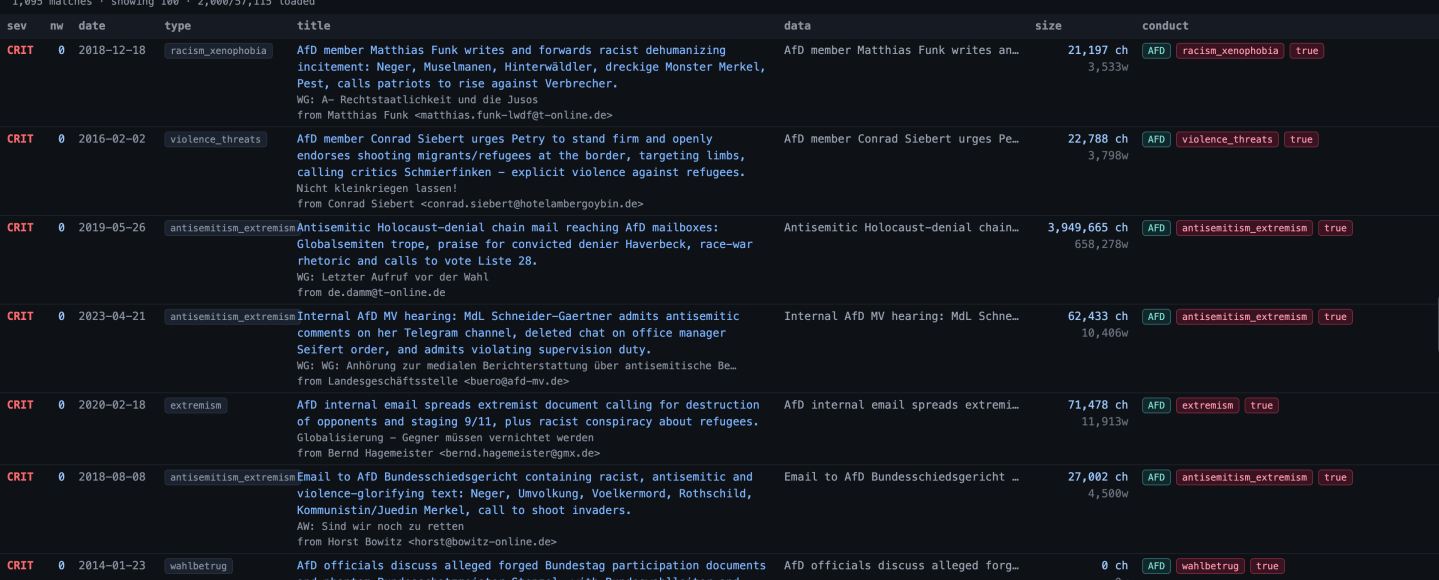
The site did not display the emails themselves, but only AI-generated digests sorted into categories such as racism and antisemitism and graded from low to critical. The complete files are available as a torrent download. According to the Party, the summaries contain errors, while verified findings have been reported relying on the original datasets.
The dataset also concerns senior party figures, including Alice Weidel. In 2017, Weidel’s local branch on Lake Constance received €132,000 from Switzerland in 18 installments, constituting an illegal donation that later resulted in a €396,000 fine for the party. When the affair became public in 2018, Weidel stated that she had learned of the payments only weeks after their arrival.
The leaked emails present a different story: in July 2017, Weidel wrote that donations to fund her social media campaign had been announced to her; the following day, she requested a sub-account “only for my personal donations”; two weeks later, she received a draft resolution granting her free disposal over donations earmarked for her campaign. Prosecutors dropped their investigation in 2021 due to insufficient evidence, which potentially has changed now. Weidel’s spokesperson says she stands by her earlier statements. However, as a candidate for chancellor, Weidel coukd now face increased scrutiny, while her initial account may not withstand public examination.
Beyond hints of financial irregularities, the archive holds something more sinister: swastikas, racist remarks, Christmas cards signed “H*** H*****” and email threads that close with “S*** H***”.
It is the nazi-ideology the party has long dismissed as ‘non-existent’ or ‘fringe’, and it appears in the files, though much of it still has yet to be verified. Internal vetting notes record applicants’ memberships of neo-Nazi organizations and their racist remarks. The archive also offers insight into the party’s early days: in 2017, a leading party figure warned that the AfD was becoming a “Höcke party,” referencing the right-wing extremist Björn Höcke, and was later punished by party leadership.
The situation continues to develop as investigators and journalists have downloaded and will review hundreds of thousands of files, and legal experts are debating whether the material could be used in the Cologne case or in a ban procedure. One conclusion is already clear: the emails appear authentic and suggest the party knew about its scandalous, potentially illegal actions and may have carried them out knowingly. What remains to be seen is what the leak will cost the party. The Graduate Press will keep you posted and continue to report on this story.


0 comments on “The AfD leak persists, and the party’s explanations are increasingly unpersuasive”