
by Béatrice Moen
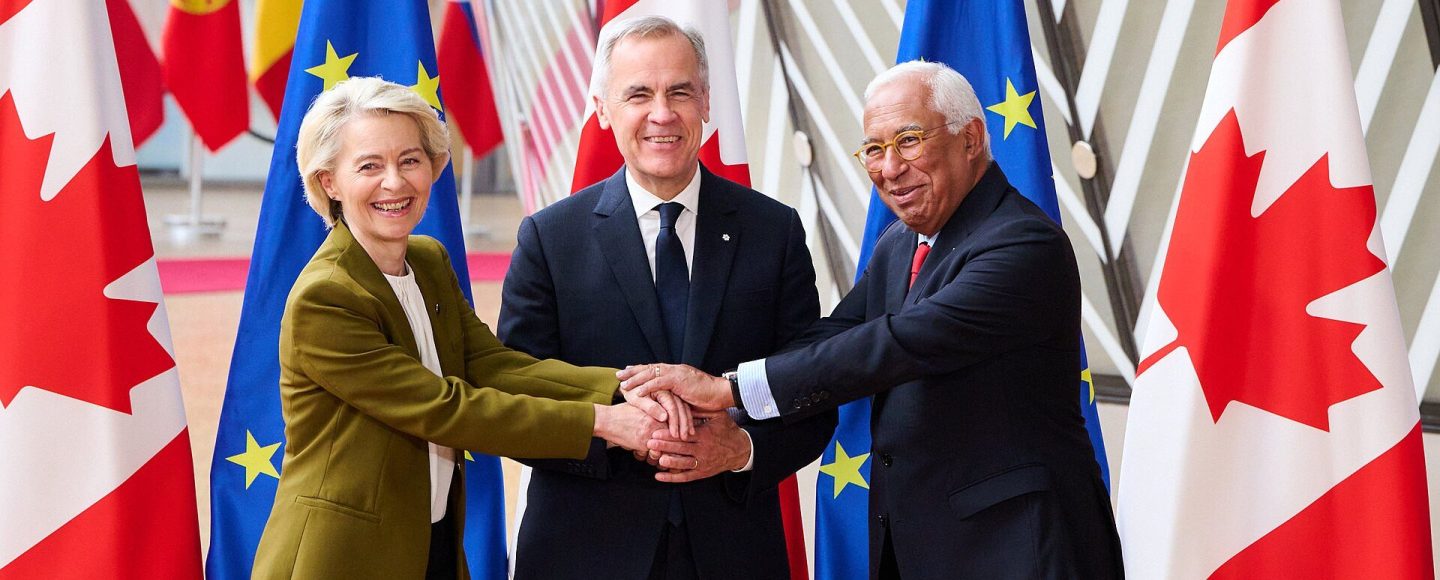
“An ocean separates Europe and Canada. Yet we have never felt closer. We have a new ambition: bringing Canada closer to us than ever before, as Associate Member of the EU,” declared European Commission President Ursula von der Leyen at the Canada-EU Summit last week. Held in Montréal, the two-day event celebrated the historic ties between Canada and Europe while outlining an ambitious new chapter in their relationship.
Von der Leyen’s proposal to make Canada an associate member of the European Union (EU), first announced during her State of the Union address in Strasbourg, marked a turning point in transatlantic relations. Yet, the precise nature of this partnership remained unclear. Associate membership does not currently exist under EU law, and its treaties restrict accession to European states. Several member states, including Germany, Italy and France, reportedly expressed reservations about the label, favouring the softer language of “ever closer association.” Nevertheless, both President von der Leyen and Canadian Prime Minister Mark Carney continued to use the terminology during the summit.
The summit offered some answers on what this partnership will actually deliver. Canada will begin processes to join the EU’s Erasmus+ programme, expanding opportunities for students to study on both sides of the Atlantic. Both parties also concluded negotiations on a digital trade agreement to facilitate cross-border data flows and advanced cooperation with the European Investment Bank to support investment in critical minerals. Canada will also participate in the EU’s Ukraine Support Loan, strengthening its contribution to European support for Kyiv.
This rapprochement comes as both parties reassess their relationship with the United States. As Washington’s increasingly erratic “America First” policies generate friction and uncertainty, Canada and Europe are seeking to strengthen their strategic autonomy through cooperation on trade, defence, artificial intelligence, and international development.
For over a century, Canada and the United States enjoyed one of the world’s closest bilateral relationships. Former US President John F. Kennedy’s 1961 declaration that “Geography has made us neighbours. History has made us friends. Economics has made us partners. And necessity has made us allies” long captured the spirit of their relationship.
Today, however, tariffs on Canadian goods and calls to make Canada the “51st state” have fundamentally altered that relationship. Trump has similarly strained ties with traditional European allies through volatile trade policies, threats to Greenland’s sovereignty, and his administration’s reluctance to supply Ukraine with additional military support in its defense against Russia’s invasion.
Against this backdrop, Canada and Europe are increasingly united by shared interests and values. Carney’s worldview is firmly anchored in the belief that the international order is undergoing a “rupture” and that countries must adapt accordingly. His address at the World Economic Forum in Davos, calling on like-minded “middle powers” to build coalitions based on shared values and interests, resonated with European leaders confronting similar geopolitical uncertainties. For Canada, whose population is comparable to California’s, securing the support of a continent of democratic allies strengthens its diplomatic standing and reinforces its sovereignty. For both parties, defending democracy amid global democratic backsliding, championing free trade amid rising protectionism, and demonstrating principled leadership amid geopolitical volatility are increasingly strategic priorities.
But this partnership is not merely symbolic. Canada’s new Trade Diversification Strategy, which aims to double non-US exports by 2035, reflects its determination to reduce dependence on the American market. Building on the Comprehensive Economic and Trade Agreement (CETA), provisionally in force since 2017, both parties are pursuing deeper economic integration. Progress is already visible: Canada recently awarded German company TKMS its largest military procurement contract in history to build its next submarine fleet. In December 2025, Canada also became the only non-European participant in the EU’s Security Action for Europe (SAFE) defence procurement programme, reinforcing transatlantic defence cooperation.
As Carney explained at Davos, the strategy is one of “variable geometry:” building different coalitions for different issues around shared interests. Its domestic appeal is evident, with polls indicating that nearly three-quarters of Canadians support the government’s efforts to strengthen ties with Europe.
European Council President António Costa described the relationship as one that would be “the closest, deepest, and most unique of its kind”. However, its unprecedented nature raises important questions. Several countries in the Western Balkans, alongside Georgia and Moldova, are pursuing full EU membership. Although there is no indication that Canada’s partnership would impede their accession prospects, granting Ottawa any semblance of preferential treatment could create tension. Moreover, without an established legal framework for associate membership, the institutional arrangements remain to be negotiated. Any eventual agreement will also require political approval, including a parliamentary debate and vote in Canada. The full scope of this partnership will therefore take shape over the coming months, with leaders expected to conclude negotiations at the European Council in June 2027.
Until then, the significance of this alliance extends beyond the agreements being negotiated. At a time when the international order is increasingly shaped by geopolitical uncertainty, Canada and Europe are demonstrating that cooperation between like-minded middle powers remains possible. Perhaps the most important outcome of this summit is not the creation of a new category of EU membership, but the recognition that neither side intends to navigate this changing world alone.


0 comments on ““Alliance for the Future”: Inside the New Canada-EU Partnership”