
by Batou Saidy
In Geneva and across the world, people see global health through different lenses. While some think it’s about power, politics, and governance, others think it’s about healthcare and humanitarian efforts across the globe. Talking about efforts, Universal Health Coverage (UHC) – the goal that all people should be able to obtain the good quality, affordable health services they need – is central in the global health discourse.
The Gambia piloted the National Health Insurance Scheme (NHIS) back in 2023. Then it rolled it out to health facilities in 2024, and now, it covers up to 70 health facilities across the nation. I attended this rollout workshop at Tendaba Hotel in the Lower River Region of the country. It looked very promising and game-changing in Gambia’s national efforts toward UHC.
While Switzerland has implemented mandatory health insurance and monthly premiums for residents, Gambia provides health insurance cards without requiring premiums. So, it looks like NHIS on paper, dalasi (Gambia’s currency) in hand. This is The Gambia’s health financing reality, falling short of the promise Africa made to itself 25 years ago. As of 2023, despite UHC efforts, “up to 33.78% of healthcare expenses in The Gambia are out of pocket.”
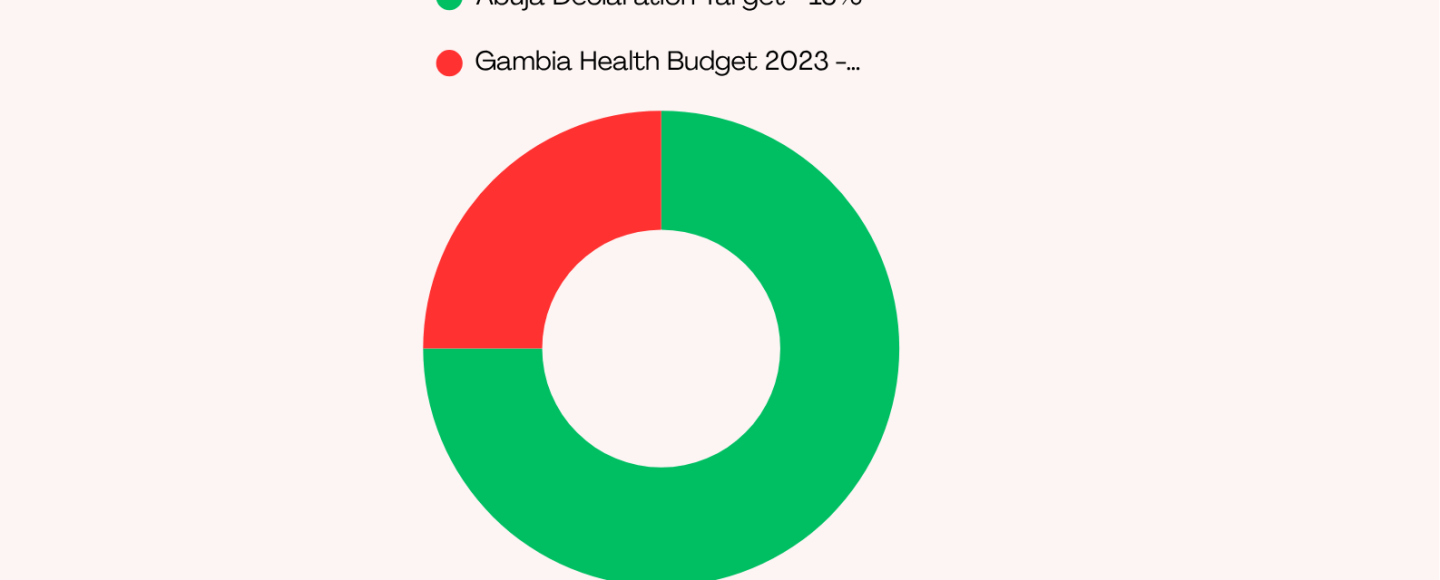
In 2001, with the Abuja Declaration, when African Presidents met in Nigeria, they pledged to commit at least 15% of all general government expenditures to health, but that promise is not in harmony with the health financing reality in The Gambia, which in 2023 allocated just 5.46% of its national budget to health, falling well below the promised cut. As a global health student at the Graduate Institute, at a critical global health discussion forum in Geneva, I decided to ask: What can Banjul, Gambia’s capital, do to increase the slice of the pie (government spending going to health) after apparently diverging from the Abuja Declaration?
The gap between the 15% Abuja Declaration and Banjul’s 5.46% in 2023 transcends how much is allocated. It highlights how much is released and, in fact, how much reaches Foni, Kiang, Jarra, and the rest of the country, especially rural Gambia. Whenever approved health budgets aren’t disbursed fully, when donors decide to donate off-budget, and health facility fees continue to be the sole insurer, that 15% promise begins to evaporate well before it reaches the patient.
At a time when global health funding is in economic distress after the withdrawal of the U.S. from the World Health Organization (WHO) in January 2025, taking along up to 90% of funding from USAID, The Gambia should devise a workable domestic health financing mechanism to fill the gaps because this is not a Geneva problem; it is now a Banjul health budget crisis. African countries such as Rwanda and Ghana have tangible domestic health financing mechanisms. With honest conversations, thorough stakeholder collaboration, proper resource mapping, and perhaps some amount of political will, The Gambia can also do it, without putting a burden on a poor farmer or housewife in rural Gambia.
Earmarking, defined as taxing what harms health to pay for health, is a great domestic health financing strategy. This doesn’t suggest any tax increment on what harms health, be it tobacco, alcohol, fuel, or sugar-sweetened beverages, but rather utilizes effective revenue-claiming and tapping mechanisms for taxes that are already in place to benefit public health.
During the recently concluded Scientific Conference of the Association of Public and Environmental Health Officers, hosted in The Gambia on 7 October 2026, I asked the Director General of the Gambia Revenue Authority whether all the revenues from tobacco and health taxes should be earmarked for health to increase the slice of the pie going to health. He noted that The Gambia’s Ministry of Health and its Non-communicable Disease Control Program should work together with the country’s Ministry of Finance to get this money. It is probably safe to hope that if the MoH enhances health governance, it could significantly increase the slice of the pie, especially given the fact that NCDs are “donor orphans” in global health while HIV, malaria, and vaccines remain “donor darlings.” This would complement the national efforts toward fulfilling the responsibility of the Abuja Declaration.
Banjul doesn’t need more promises. It needs three tangible moves: earmark health taxes, bring Development Assistance for Health on-budget, and publish budget release data. If The Gambia does this, it is effectively practicing domestic health financing polygamy. That could potentially close the health financing gap confronting the country.


0 comments on “The 15% Promise: Assessing The Gambia’s Health Financing Gap”