
by Maya Mueller-Perron
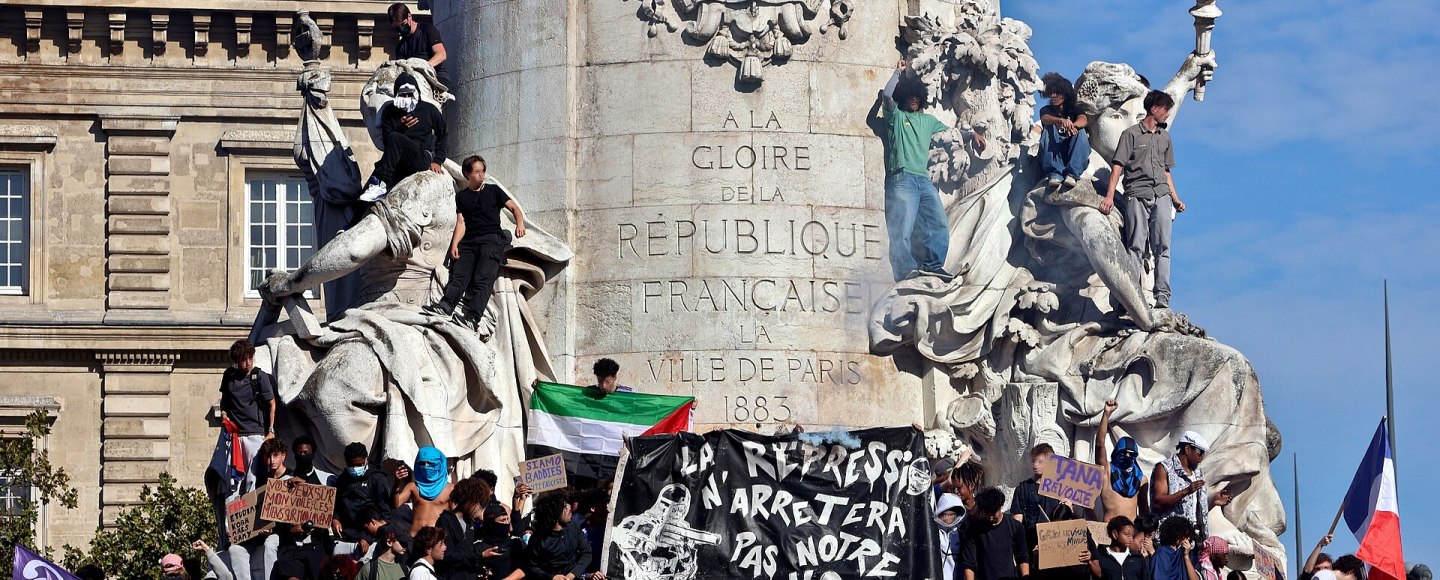
Throughout history the French have shown that they know how to protest — often and thoroughly. Yet, this cultural tendency to “take it to the streets” is insufficient to explain the combustible atmosphere France has been plunged into since last weekend. How then did a spontaneous and peaceful student protest in Créteil asking for little more than a pen and a teacher snowball into the violent riots we witnessed this weekend? To understand this convergence des luttes (convergence of struggles) it is essential to look behind the country’s political curtain.
To set things straight: The pillaging of stores and violent destruction of public buildings that took place this weekend by a few individuals are appalling and must absolutely be condemned. Yet, the political debate at hand is another one. It is one that demands to hold politicians accountable for years of deteriorating public services, widening inequality, and a governing style that has left citizens feeling unheard.
The wonderful expression of “having” “ras-le-bol”, literally a bowl filled right to its brim, can loosely be translated to “being fed up” and has been echoed by students, teachers and yellow vest unionists alike. It epitomises despair turned into anger at deteriorating public services and infrastructure and the realisation that France’s governing elite has lost connection to its people. President Macron was said to attend Céline Dion’s concert while students were rioting in the streets, encapsulating the frustration against a class of politicians, evidently disinterested in the struggles of their country’s people.
That protests have fired up (literally) comes as no surprise after nearly a decade of Macronisme has marked the country, a centre-right, top-down governing style of the incumbent French president. Over the last nine years, inequality has reached a “historically high level”. Budget cuts have hollowed out public social services like education and healthcare. This has resulted in job cuts in middle and high schools, leaving 20 per cent of classes with more than 35 students and classrooms heating up to 40 degrees Celsius during last summer’s heatwave. The reasons for this social collapse are economic stagnation and skyrocketing budget deficits, so severe that observers have begun warning of a looming sovereign debt crisis. To turn things around and respond to his abysmal 15 per cent approval rating, the former investment banker and now president cut wealth taxes, hoping to win back far-right voters. The result of this decade of unchecked free-market policy, as protesters have made clear, is Paris set ablaze.
The students’ malaise, however, runs deeper than crumbling high school ceilings. It reflects a broader despair about a future marked by climate catastrophes, rising right-wing politics, and the persistent systemic issue of social mobility. Indeed, French students, more than in any other European country, have been pushed since early childhood to make decisive choices about their educational paths, determining their possibilities to access secondary education. Education minister Élisabeth Borne’s illustrated this when unironically affirming that: “Il faut se préparer à son orientation professionnelle dès la maternelle”, (You must start preparing for your career path as early as preschool), highlighting the extent to which the French system frames education less as a space for exploration than as an early sorting mechanism geared toward professional outcomes. Sociologist Camille Peugny argues that the state increasingly shifts the burden onto families to guide their children into the grandes écoles, elite institutions essentially designed to reproduce a social, political and cultural elite. To end this veil of meritocracy, in which academic success is boasted as completely independent of economic and cultural capital, students thus demand the abolition of the anxiety-inducing online system Parcoursup. Created as a centralized platform for higher education applications, it has since become the symbol of an education system corrupted by economic principles of productivity, performance, and constant competition. That this exasperation in the face of increasingly unattainable upward mobility is not just a subjective feeling is substantiated by OECD findings that intergenerational income inertia in France stands at around 52 per cent, against under 40 per cent for the OECD average, placing France among the worst performers in Europe.
The geographic dimension, which in France has a deeply racial dimension, has also fuelled the growing resentment against the government. Unlike most European capitals, France is extraordinarily centralised, making Paris a meritocratic epicentre where the country’s cultural, economic and political elite is concentrated on only a little more than 100 square kilometres. This ultraconcentration creates a stark economic divide between the capital and the rest of the country, which academics have coined a geography of discontent, describing how territorial inequalities explain rising political frustration. Affordable housing has in this reality become an unattainable dream for many, pushing the most vulnerable, which unsurprisingly disproportionately concerns families of immigrant background, to the urban periphery. This divide is mirrored within Paris itself, where well-resourced private schools sit only streets away from public ones whose walls, protestors claim, are infested with rats and cockroaches. Notably, students from these private establishments joined the protests in solidarity with their peers, signalling a very clear awareness of the difference in educational conditions and state responsiveness to these.
While violence is not the main topic here, it is remarkable how a young generation has applied their history lessons in the streets and, above all, shown incredible resilience in mobilising and sustaining a movement that is, for the most part, peaceful. More than that, they have also proven their analytical grammar in theorising violence. Faced with tear gas, grenade launchers and numerous cases of undeniably violent acts perpetrated by the police, students have not only condemned the violent repressions by the police apparatus but also weighed the protestors’ reactions against a long-lasting institutionalised form of violence, asking whether “damaging public services might not be a form of violence too?”
With elections coming up and polls looking everything but promising, it is important to condemn any excess of violence against public and private property. Most importantly however, it is essential not to lose track of the protestors’ concrete demands. After the violent protests this weekend, right wing politician Jordan Bardella capitalized on the riots promising to restore order, offering a textbook example of authoritarian securitization discourse.
If Paris is burning, it is because a generation was told to prepare for a future that offered them less and less to hope for. While the flames will eventually die down, the demands will remain and with them, the reckoning the government has long postponed.


0 comments on ““Paris is burning” – A French feeling of “Ras-le-bol du Macronisme””