
by Puhiza Shemsedini
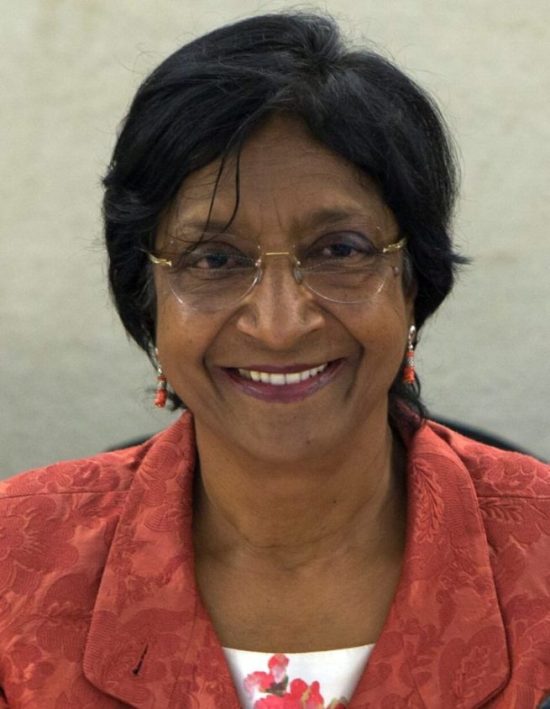
This month, the Norwegian Nobel Committee awarded the Nobel Peace Prize to Navi Pillay “for her efforts to promote peace and international law.” Announcing the award, the Committee’s chair praised her “exceptional courage and integrity” and credited her with making sure that war crimes, crimes against humanity, and genocide are prosecuted.
Pillay was born in 1941 in Durban, South Africa into a family of Indian Tamil descent, and grew up under apartheid. In 1967, she opened her own law practice in Natal, the first woman to do so, and went on to defend anti-apartheid activists, among them Nelson Mandela. She would later become the first woman of colour on South Africa’s High Court.
Her career then moved to the international level: as a judge, and later president, of the International Criminal Tribunal for Rwanda, she helped establish landmark precedents recognising rape as an act of genocide. She then sat as a judge at the International Criminal Court, served as UN High Commissioner for Human Rights from 2008 to 2014, and currently acts as an ad-hoc judge in the Gambia v. Myanmar at the International Court of Justice.
Most recently, she chaired the UN Comission of Inquiry on the Occupied Palestinian Teritory, which in September 2025 concluded that Israel was responsible for four genocidal acts in Gaza and that senior officials had incited genocide. Israel categorically rejected the report.
Shortly after the announcement that she had won the Nobel Peace Prize, Pillay said it surprised her that the report regarding Israel’s genocidal acts in Gaza was being met with praise for her bravery: “Why would you need courage to speak the truth?”
Furthermore, the fact that Pillay received the news in Nuremberg, specifically in the building where the first international criminal tribunal was set up to judge the crimes of the Nazis, speaks volume in itself.
Pillay also dedicated the prize to all of the survivors of international crimes and to those who defend international justice. She will formally receive it in Oslo on 10 December.
The award comes at a pivotal moment for the international community, as international law faces mounting challenges, and the credibility of the institutions tasked with upholding it is increasingly under scrutiny.
Only hours after the award news went out, the US imposed sanctions on the International Criminal Court.
As the UN High Commissioner for Human Rights, Volker Türk said the prize carries particular weight because it comes while human rights are being attacked on many fronts, including by people who hold enormous power.
The Norwegian Nobel Committee chair Jørgen Watne Frydnes warned that power politics are increasingly pushing aside legal frameworks and that stability and peaceful coexistence suffer whenever force prevails over right. He acknowledged that the system has never been flawless, since powerful states have often avoided responsibility, but noted that lasting peace must rest on legal principles rather than the will of the strong.
This award likely signals the wider turmoil in the global order. That international law is dead, or at the very least in crisis, has become a common narrative in academic and public-wide debates, fueled mainly by disappointment in the international community and institutions that have failed to stop genocides, crimes against humanity, and grave violations of human rights.
This prize is, in a way, a reminder amid this scepticism of the continued importance of international law and the principles enshrined in the United Nations Charter, particularly its call to “reaffirm faith in fundamental human rights”.
The UN Secretary-General António Guterres described the prize as a tribute to everyone working to uphold international law, the rule of law and human rights
Although the prize does not have implications on the ground, its message is loud and clear: that international law is well alive, needed more than ever, and adherence to international law should triumph over attempts to disregard it. For those of us who care about human rights and justice, this is a reminder worth taking from this prize. Because the law is only as alive as the people who keep using it and defending it.


0 comments on “Navi Pillay’s Nobel Peace Prize: A Signal of Hope for International Justice”