
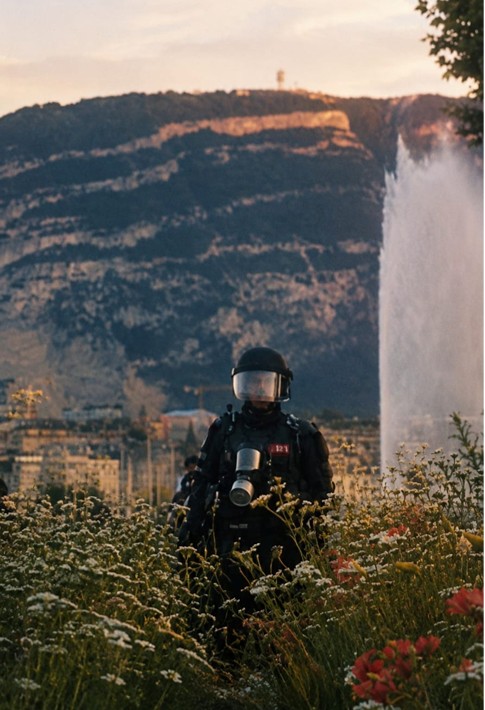
By Wassim Atrissi, Itzhak Dorai, Noa Sara Lehmann
On June 14th, the G7 summit came to Geneva, and with it, protests, checkpoints, and a police presence that had taken over the city for days. On the day of the demonstration itself, thousands marched against the G7 and for the feminist march that happens every year on this day.
We are three students from the Geneva Graduate Institute who later found ourselves unjustly detained together in a police kettle. We are writing this because we think what happened that night deserves to be talked about, not just as an isolated incident, but as a tactic increasingly used across Europe to manage protest.We each wanted to tell it from our own experience, because even standing a few meters apart, we lived this night differently and yet the same.
Sunset to Sunrise
Days before the G7 summit, a tension the entire city could feel had already arrived. Military helicopters circled overhead, police officers from Germany and France walked the streets in uniform, and the whole city had suddenly been barricaded.
The night before the protest, my friends and I talked about what we expected and how we would look out for each other. Little did we know that less than twenty-four hours later, we would be kettled until the morning.
The demonstration itself was nothing like what I had expected from the pictures I had seen of other G7 protests. People from all different movements and organizations were coming together that day, singing Bella Ciao under the sun and moving slowly on the dedicated protest route. Sometimes in the part of the protest, I was walking, it was surprisingly silent. This stood in stark contrast to the image most news channels led with. The one burning Tesla.
Toward the end, tear gas was thrown into the crowd. My friends and I had decided beforehand that we did not want a confrontation, so we stayed back. We still got tear-gassed, but we were far enough away to move quickly back into the park where the demonstration had started. Protesters and police were clashing, with fireworks thrown from one side and tear gas and water cannons from the other, and the fighting blocked the peaceful protesters from reaching the end of the march. Luckily, at one point, we managed to reach the park without getting pulled into the conflict.
At around 7:15 we ended up sitting there as the noise from the protesters and the police slowly faded. At some point it felt almost like any other day in that park, the same spot we sit at every day. Talking and resting and wanting to go for a swim in the lake.
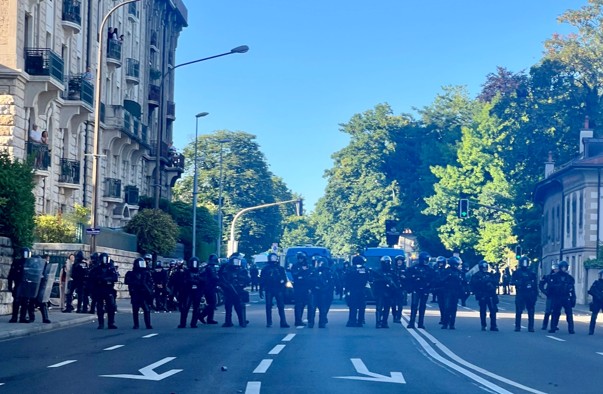
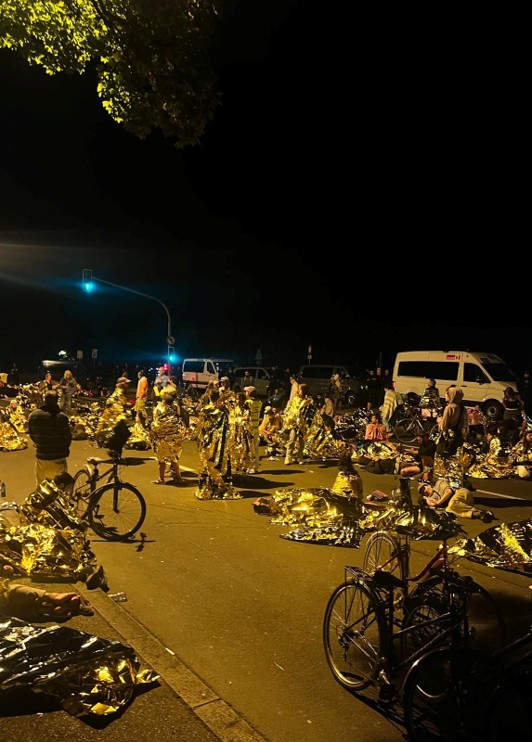
That was when I saw them. Two hundred officers walked toward us in formation. I called a friend who told me the police were already at the other exit of the park. I knew immediately it was too late to leave. Around two hundred people who were still in the park, or had simply passed through after work, were kettled. For hours nobody told us why we were being held or when it would end. In the beginning I thought maybe we would be out by one or two in the morning. Instead they started handing out water and blankets around that time. At this moment, I understood that I was not going home before sunrise. They gave us no food, no toilets, no justification. Sitting a hundred meters from the UN Human Rights Council, I thought to myself: Welcome to Geneva, the city of human rights.
At the beginning I was frightened that someone would fight back against the police, and that the police would then turn violent against all of us. All that apparatus, all those officers, all that tension built up over days, and now we were inside of it. And then, slowly, something else happened instead.
People started doing yoga. Some people started singing. Cards came out. And strangers shared their last food with us. The choice not to give the police what they seemed to be waiting for was a political decision even if nobody called it that. We collectively refused to become what the situation was designed to produce.
At around 5 am, my friends and I tried to finally leave the kettle. After waiting in line, they took our IDs and a picture of us without explaining what would happen with the information.
I believe the police mission that night was collective punishment. I think they were expecting some kind of violence to break out. What they got instead was people doing yoga, sharing their last food and jackets with strangers.
When I got home I felt empty. I tried to sleep and talk through what had happened with my roommates, who had shared the same night with me. At some point, my exhaustion faded and what came instead was rage. Not the kind that makes you want to break something. The kind that clarifies that what happened at this G7 protest was definitely not an exception. Across democratic European countries, movements are being criminalized, and democratic backsliding is real. The same states that export violence and uphold imperial interests abroad do not leave that logic outside of our borders. It comes back, shows up in kettles, ID checks and data collected without explanation at 5 am in the morning.
I believe we cannot rely on our rights to simply exist. For many people, this has never been a choice. All our rights have to be defended. That night was frightening and uncomfortable, and I would not wish it on anyone. But I know what I went to the streets for, and I know I am not in this fight alone. The police can contain people for one night. They cannot contain what made us go there in the first place. And if that night was meant to keep me off the streets, it failed. I will be back!
When are we leaving?
Around 8 pm, I was ready to go home.
The protest had ended for me. The chants were over, the march was finished, and what remained felt almost ordinary. People were sitting by the lake, talking, resting, waiting. It did not feel like a confrontation anymore.
A friend and I decided it was time to leave.
Then someone told us we couldn’t.
At first, I did not really understand what that meant. Couldn’t leave? We were in Geneva, next to the lake, in the middle of the city. There was no gate, no wall, nothing that suggested we were inside anything.
Someone said the word: nasse.
I had never experienced it before. I did not know what being kettled actually meant in practice. It sounded like a crowd-control technique, something temporary, something distant. A police strategy you read about, not something that changes your evening.
Then, slowly, the circle became visible.
More police arrived. The spaces that looked open were closed. The exits disappeared. The possibility of leaving became something that belonged to someone else.
By around 9pm, the encirclement was complete.
That was the moment I understood that the question had changed. It was no longer “when do we want to leave?” but “when will they let us leave?”
At first, I thought the purpose was security. To contain the situation, stop clashes, identify people who had caused trouble. But the longer we waited, the less convincing that explanation became. The people who wanted confrontation had mostly already left. What remained were peaceful protesters, students, people sitting by the lake, people who had simply not walked away early enough.
The nasse became less about stopping an action and more about waiting.
And waiting changes people.
The sun disappeared. The temperature dropped. Phones started dying. Conversations that were political an hour earlier became practical: battery percentage, water, food, toilets.
Small things became important because small things were what we no longer controlled.
At some point, I was contacted by someone with legal knowledge who knew I was inside the kettle. They advised me to remove anything on my phone or social media that could connect me to the protest, just in case there were consequences. I repeated the advice to my friends.
That was when my own position inside the crowd changed.
I was not only thinking as a protester anymore. I was thinking as a foreign resident.
I was not Swiss. I was not European. My friends and I were students living here with residence permits. Even if we had done nothing wrong, the possibility of being identified by the police carried a different weight. We did not know if the consequences would be the same for us.
The nasse made everyone wait, but not everyone waited in the same way.
Inside, people started organizing themselves. The crowd almost created its own geography. There was an inner circle protected by protest volunteers, who positioned themselves around people in case the police moved in. Then there was the outer circle, those sitting directly facing the police line.
Between these two spaces, people moved back and forth, choosing where they felt safer.
We were four friends. Two were becoming increasingly stressed. One wanted to speak with the police, to establish some kind of relationship, to show we were cooperative.
At the time, I did not understand why.
To me, it felt unnecessary. Almost like trying to win the approval of people who did not have the power to decide what would happen to us anyway. The officers standing in front of us were probably not the same ones who would later check our identities.
But he saw it differently.
He thought that if we showed respect, if they saw us as reasonable, maybe things would be easier.
Looking back, that disagreement itself showed how the situation worked. The police did not need to use force for us to start adjusting our behavior around them.
We were already negotiating with power.
Hours passed.
At one point, frustration spread through the crowd. People began shouting. Not political slogans anymore — something much simpler.
They wanted toilets.
It was almost absurd, but also revealing. The confrontation had moved away from ideology. It was now about basic needs: water, bathrooms, warmth, the ability to leave.
Around midnight, the police announced they would start letting people out.
We were lucky. We happened to be close to where the exit was created.
It still took three hours.
Three hours of standing in a line that barely moved. Three people would leave, then another three. Slowly, individually, the crowd disappeared.
When my turn finally came, they took my residence permit. They photographed it. Then they photographed my face.
They told me they would contact me if they suspected anything.
And then I was allowed to leave.
Outside, protest groups were waiting with food, water, and legal information. After hours of being treated as something to manage, there was something strange about being welcomed again simply as a person.
The nasse did not end the protest through violence.
It ended it by transforming everything around us: our time, our bodies, our decisions, our relationships with each other.
By making leaving impossible, it made permission the only way out.
On Whom it Works Best
After the protest, we decided to hang out by the lake. There were still some people, and the police were slowly pulling back as the crowd thinned.
Wanting to join some friends by Bain des Paquis, we walked down the quai until the police told us to turn back. We said we wanted to head home, and they said it wasn’t possible this way. After a quick loop around, we realized we simply couldn’t leave.
Une nasse. Of course, I knew the term and the strategy. I also knew, from what my family told me, how these often ended. People were worried the police would charge the crowd. They didn’t. They stayed put, barely moving now. We were completely trapped. Yet inside this cordon, we all lived these 6 hours differently.
The 3 people I was with and I sat down at the foot of the wall of policemen. We asked them what we had to do to avoid trouble, and they refused to answer, several times. But after a while, we could see the tiredness on their faces. And then they started talking a little more. The mood got lighter, slowly. Until one made a simple joke, how the weather was just right for a swim in the lake.
My grandpa would never talk about it, the time when the French police threw Algerians in the Seine in 1961. My mom would tell us about it. She’d remind us to be careful of the police. She would list for us the times the police killed. And often, she would go back to 1961. Even if I knew he wasn’t a French cop, even if we weren’t in Paris, even if I knew he was just joking, I couldn’t help but feel the fear.
After a few hours, they opened an exit. We had to stand in line, and they’d handpick 3 people to go through a security check. Those 3 could leave, and then they’d pick 3 again. A slow and tedious process. I was standing next to a Kurdish guy my age. We started talking. He was very worried, as he didn’t have his ID with him. The police refused to answer his questions about what he should do, over and over. We were both in the very front of the line, waiting to get picked. People had grown frustrated, after waiting for so long. They insulted the police, pushed, and demanded their rights. The more they grew frustrated, the more we were worried. I had been taught to comply. We both had, in different ways, from different places. Because non-compliance had consequences we already knew. The balance of power was fully in their favor.
Low-intensity strategies of crowd management don’t only work at the moment. They work over years and over generations. These passed-on lessons of police violence teach you to comply, without needing to exert physical violence.
The kettle doesn’t need to hurt you today. It only has to remind you that it already did, once, to someone you know, and that it could happen to you too. In this case, the state doesn’t protect you. It treats you as a suspect, the moment you protest, criminalizing the act of being there at all.
Concluding Thoughts
The kettle held all of us behind the same line, but what happened to each of us inside it depended on what we already carried.
As one of us writes, low-intensity strategies don’t just work in the moment, they work over years and generations. For one of us, that meant a joke about swimming in the lake reaching back to 1961. For another, it meant watching a residence permit change what the night could cost. For another, it meant discovering the power of deciding, alongside strangers, not to become what the night wanted from us.
That is what makes the kettle so hard to name as violence, and so effective. It ended the already ended protest not through force but by transforming our time, our bodies, our decisions, and our relationships with each other, making permission the only way out.
We are writing this down because, as one of us puts it, rights do not simply exist. They have to be defended, and that starts with saying plainly what a night like this actually does.


0 comments on “What the Kettle Left Behind: Reflections on the G7 Protest in Geneva”