
By Gregory Wagner
A new exhibition at the Château de Prangins asks uncomfortable questions about Swiss history – and, crucially, about the present.
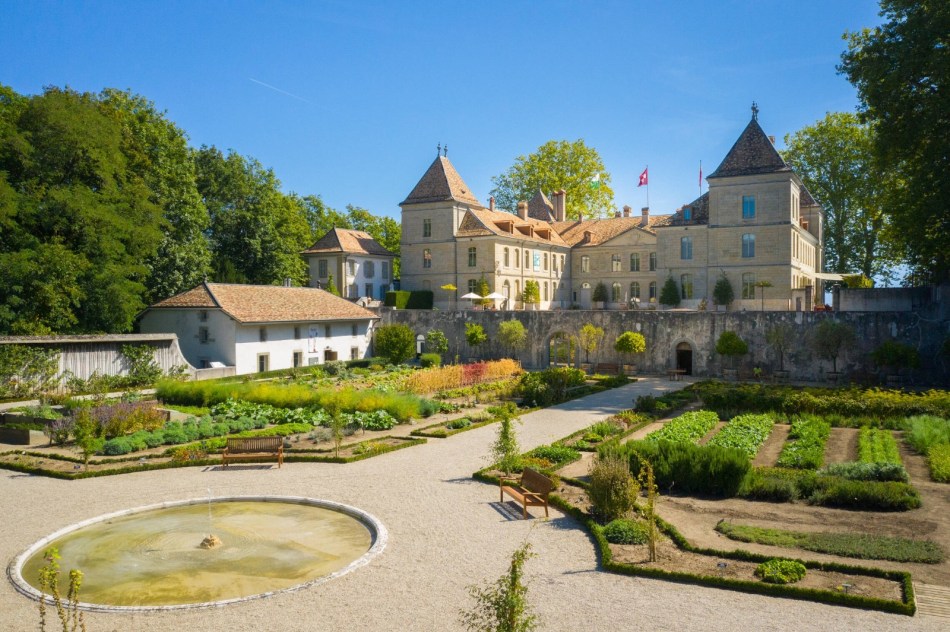
The myth of Swiss neutrality has long extended beyond the realm of politics. Switzerland, a landlocked country with no overseas territories, has often claimed to have stayed out of the violence of European colonialism. A major new exhibition, which opened at the end of March at the Château de Prangins, a branch of the Swiss National Museum, sets out to emphatically refute this assumption – with the evidence to back it up.
“Colonial. Switzerland’s Global Entanglements”, first shown in 2024 at the Swiss National Museum in Zurich and now presented in an adapted form in French-speaking Switzerland, offers the first comprehensive overview of the history of Switzerland’s colonial involvement. Drawing on the latest scholarly research, artifacts, artworks, archival photos and documents, it presents evidence that is hard to ignore. The result is less a museum display and more a contribution to an ongoing national debate on identity, responsibility and memory.
The extent of Switzerland’s involvement is striking. Swiss companies and individuals participated in the transatlantic slave trade and amassed wealth through the trade in goods produced by slave labor. They also served as mercenaries in European armies sent to crush the resistance of indigenous populations. The exhibition notes that over 250 Swiss companies and individuals were involved in the trade and deportation of approximately 172,000 people – figures that are difficult to reconcile with the Helvetic self-image. To put this in context: The transatlantic slave trade is widely seen as the largest mass deportation ever recorded in history, and Switzerland was not a passive bystander.
The show’s nine thematic chapters trace Swiss involvement across continents and centuries. The chapter on trade, for example, illustrates how Swiss trading companies evolved from the 16th century onward into global commodity traders dealing in textiles, spices, sugar, cocoa, coffee and cotton, goods whose production depended on slave labor. Geneva and Switzerland remain important hubs of the commodities trade to this day, a continuity that the exhibition addresses without reservation. A chapter on settler colonies, meanwhile, examines how Swiss emigrants, most of whom came from modest backgrounds, nevertheless benefited from established colonial power structures and participated in the violent displacement of indigenous populations in the Americas and beyond. The names of cities such as New Bern in the United States still bear these traces.
The historical role of universities was also examined in detail. The museum showed how the anthropology departments at the universities of Zurich and Geneva were complicit in academic racism and disseminated racial theories that were adopted internationally to lend supposed scientific legitimacy to a system of global domination. These were not marginal phenomena: they were part of the official curriculum. The display also explores the “colonial gaze”, the racist and exoticizing depictions of colonized peoples, that were widely disseminated in Switzerland through published reports, photographs and travelogues and examines how this gaze persists in the collective memory to this day.
The second part clearly shifts the narrative to the present and traces colonial continuities manifested in structural racism, global wealth inequality and environmental destruction, the consequences of which are still unfolding. Switzerland’s role in perpetuating the apartheid regime in South Africa through illegal arms exports, secret nuclear agreements and large-scale gold banking transactions is examined with a particular focus. The ongoing debates surrounding art restitution and the presence of colonial figures in public spaces are also addressed, anchored by a striking bronze sculpture by the Geneva artist Mathias C. Pfund: a miniature of the statue of David de Pury, the Neuchâtel merchant involved in the 18th-century slave trade, cast upside down.
The collection leaves no visitor unchallenged. An interactive video installation invites visitors to reflect on the traces of colonialism in their daily lives, while a concluding section provides a space for discussions on reparations, institutional responsibility and the significance of the colonial legacy for Switzerland today. For students at an institution whose own history is closely tied to Geneva’s role as a cosmopolitan city – and to the international legal and economic frameworks that have regulated and sometimes even perpetuated global inequalities – the questions raised here are anything but abstract.
A rich supporting program runs parallel to the exhibition, including guided tours, film screenings and a “living library” in collaboration with the Maison de l’histoire at the University of Geneva.
For anyone living and studying in Geneva, a city whose wealth, institutions and global influence are themselves part of the story being told, it offers an unusually rare opportunity: to sit with that discomfort in a structured, thoughtful way and to leave better equipped to engage with the debates that will hopefully continue long after the exhibition closes. The Château de Prangins is easily reachable from Geneva by train, with the castle a short walk from Nyon station. The exhibition is open until 11 October 2026, long enough that there is no excuse not to go and interesting and important enough that you really should.
Colonial. Switzerland’s Global Entanglements runs at the Château de Prangins, just outside Nyon, from 29 March to 11 October 2026. Full programme details at https://www.chateaudeprangins.ch/colonial



0 comments on “Switzerland’s Colonial Entanglements: An Exhibition at Château de Prangins”