
By María Juliana Rodríguez Urbano, Student Life Editor of The Graduate Press
From 8 to 17 March 2024, Geneva held the 22nd edition of the International Film Festival and Forum on Human Rights (FIFDH). The festival presents films and encourages discussions around promoting human rights, providing a space for activists, NGOs, artists, diplomats, journalists, academics, students, and the public to exchange ideas on how to approach human rights globally. At The Graduate Press, we covered FIFDH by attending film screenings and talking to some of the festival’s guests.
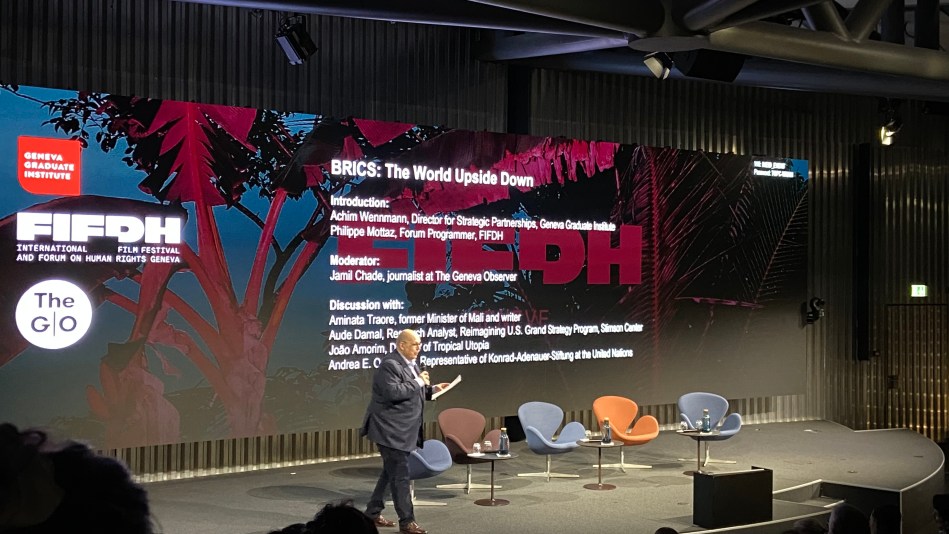
One such screening was for the documentary Tropical Utopia, directed by João Amorim. A conversation between American linguist and philosopher Noam Chomsky and Brazilian diplomat Celso Amorim, the documentary looks at the political, social, and economic issues that have shaped Latin America, focusing on Brazil. The screening was held at the Graduate Institute during the event “BRICS: The World Upside Down” and was followed by a panel discussion.
Chomsky and Celso Amorim look at how the United States positioned itself as a hegemonic power during the Cold War and how it sought to exercise influence in the international sphere. One way of doing this was implementing a foreign policy aimed at tackling what was deemed the “communist menace” in its next-door neighbor: Latin America. This provided controversial outcomes, with an apparent economic boom in the region, which resulted in revenues for the United States and political oppression and violence in Latin America. Chomsky and Celso Amorim talk mostly about Brazil and how the end of its dictatorship (backed by the United States government) in 1985 changed how politics are done in the country.
The documentary shows how Brazil shifted gears towards the left of the political spectrum after the presidential election of activist Luiz Inácio Lula da Silva in 2003. This new government spearheaded the strengthening of Petrobras, the country’s national oil company and one of the largest in the world. Brazil then became a relevant actor in the international community, resulting in the country founding the BRICS group with Russia, China, and India. The group went from an initiative to highlight investment opportunities between these countries to a geopolitical bloc coordinating multilateral policies and being considered a rival of the G7 bloc.
Nevertheless, as Chomsky and Celso Amorim point out, Brazil’s path has been rocky in the past years, especially after the presidential election of Jair Bolsonaro in 2018. A retired military officer who vocally supports the country’s dictatorship, he used his position as a congressman to advance his far-right views. He capitalized on the rejection a large portion of the population had toward their traditionally left-leaning government. This sentiment increased after the Operation Car Wash (Operação Lava Jato) case, in which there was a massive corruption scheme in the government and state-owned companies such as Petrobras. The scheme was so big that it ended up with the removal of then-president Dilma Rousseff from office and affected several Latin American governments.
The documentary concludes by looking at how Brazil ended up being a parallel to the United States, even after all these years of positioning itself as an alternative in the region. With Bolsonaro, Brazil mirrored American politics of the moment: misinformation, populism, gun violence, and outright discriminatory speeches that sought to make people angry rather than passionate about a cause. But not everything seems lost. In 2022, Lula da Silva (after being in prison for a year and a half under wrongful charges of corruption and money laundering) became president again, defeating Bolsonaro. Chomsky and Celso Amorim agree there is much work to be done, as Brazil – and Latin America – still struggle with corruption and polarized politics. However, there is a visible change in how the country and the region have slowly stepped away from its powerful neighbor from the north and proved they are not anyone’s backyard.
Throughout the documentary, João Amorim (son of Celso) strives to highlight the influence of the United States in Latin America and the international community. To counter this, João Amorim sets China as the bigger player emerging in the past decades, forging powerful economic relations with Latin America and effectively earning the trust of a region that has had problems trusting their neighbor and largest financier. To convey this, João Amorim uses effective animation sequences that portray China as a likable panda bear and the United States as a mean-looking bald eagle trying to “protect” its backyard (Latin America).
But what João Amorim misses are the hidden interests behind that likable panda. China has become a large investor in the region, spearheading innovation and improvement in areas such as infrastructure. Nevertheless, this relationship often comes with a “fine print.” One case is Ecuador, which has seen its natural resources (and some argue its sovereignty) compromised by economic deals with China. Shortly after Rafael Correa was elected president in 2007, Ecuador defaulted on its foreign debt. In 2009, the Chinese oil and gas company PetroChina (part of the state-owned China National Petroleum Corporation) lent one billion USD to the Ecuadorian government in an agreement stipulating that the national oil company, Petroecuador, sell its crude to PetroChina.
This relationship continues until today with several loans and credit lines given by PetroChina and Chinese banks. By 2013, China had helped cover around 61% of Ecuador’s financing troubles whilst taking nearly 90% of the country’s oil shipments since then. This economic dependence has caused harm to Ecuador’s resources as China has claimed the payment of the debt by gaining almost unrestricted access to its natural reserves and causing harm to indigenous peoples’ livelihoods.
There is no question regarding the influence of the United States in Latin America during the 20th century and the consequences this has led to today. Democratic governments, seeking greater independence from their neighbor in the north, were unlawfully overturned in favor of brutal US-friendly dictatorships that completely changed the political, economic, and social spheres in the region. The BRICS group and Brazil’s rise in this context exemplify that. However, it is also important to remember that the alternative is no better than the known evil. China’s presence in the region has raised eyebrows about the economic dependence it is creating among these countries. Additionally, the silence coming from the BRICS countries on Russia’s invasion of Ukraine – justified by the fact that the group is founded on a premise of non-interference – is concerning, to say the least.
Sometimes, the enemy of my enemy is not my friend but merely a different version of my enemy.
Photo credits: María Juliana Rodríguez Urbano


0 comments on “Alternative imaginaries? A film review and analysis of the documentary Tropical Utopia”