
by Isabelle Costa & Ege Orhun Yagci
The world’s fourth-largest democracy, Brazil, held its presidential election last Sunday with approximately 120 million citizens casting ballots. Ranked among the world’s most politically polarized nations (4th), Brazil entered this election under elevated tension following the January 2023 assault on government headquarters by supporters of the former president Jair Bolsonaro and later his prosecution. This contest represented a critical evaluation of the country’s democratic resilience.
The election took place against a backdrop of recent right-wing electoral gains across the Americas. The re-election bid of the incumbent, President Luiz Inácio Lula da Silva, tested whether this ideological shift would take place. This article presents a closer look at how President Lula managed to win in the second round, the interference claims, and what this might mean for South America’s political future.
Demographics of the Election
In the first round of the election, conservative candidate Flávio Bolsonaro secured a plurality over incumbent President Lula, driven by high turnout in the southern and southeastern strongholds and inroads into the historically left-leaning Northeast.
Bolsonaro’s initial advantage was amplified by strong mobilization among Evangelical Christians which is one of Brazil’s fastest-growing and political voting blocs. Conversely, early voter engagement among Lula’s broader coalition was uneven, tempered by persistent economic constraints. In the runoff, however, the wind has shifted in the opposite direction. Leveraging focused debate performances and aggressive ground-game operations, Lula expanded his margins across the Northeast and mounted a critical comeback in Minas Gerais, the nation’s second-largest and premier bellwether state.
Lula’s second-round resurgence reflected a successful reconsolidation of his coalition: mobilizing both educated, anti-Bolsonarista urban progressives and the traditional, socio-economically vulnerable working-class voters drawn to his historic political legacy. This dual mobilization strategy proved decisive in overcoming first-round abstentions and winning the runoff. Ultimately, this strategy overcame first-round voter fatigue, checked the regional conservative wave, and secured a victory in a polarized democracy for President Lula.
Allegations on Interference
Although the contest between Lula and Flávio Bolsonaro may seem similar to 2022, Brazil’s 2026 elections differ from previous ones in several respects, including geopolitical tensions, allegations of interference, and disputes over social media platforms.
U.S. pressure: The tariffs imposed by Donald Trump in 2025 in response to the trial of former president Jair Bolsonaro signaled Washington’s willingness to use economic pressure in Brazil’s domestic political disputes. In 2026, further developments fueled concerns about U.S. interference, including the designation of the PCC and Comando Vermelho as terrorist organizations, challenges to Brazil’s Pix payment system, joint military exercises in the Peruvian Amazon, and the suspension of consular services at U.S. diplomatic missions in Brazil two days before the first round. Meanwhile, the Federal Police closed a preliminary inquiry into alleged U.S. funding for initiatives targeting Brazil’s Supreme Court, citing insufficient evidence to proceed.
Digital platforms: After the first round, Lula’s campaign reported restrictions affecting the President’s accounts and problems with recommendations promoting content favorable to Flávio Bolsonaro on WhatsApp, Facebook, and Instagram. On 15 October, the Superior Electoral Court (TSE) ordered Meta not to interfere with the distribution of political-electoral content related to any of the candidates. In a statement released on Wednesday, 21 October, independent experts from the United Nations (UN) also reported that accounts linked to Lula’s campaign were disproportionately affected by suspensions, sharing limitations, and reduced reach.
Disinformation: A video by the bolsonarist deputy Nikolas Ferreira was made to challenge the prevailing narrative about Brazil’s Northeast, where Lula enjoys his strongest electoral support, but behind-the-scenes footage raised questions about how scenes were directed to purposely portray poverty. Controversy intensified after one man portrayed as poor was identified as the owner of a Toyota Hilux, which his defense said he used for work. Relatives of the woman who claimed to have cancer also stated that she was already cured and enjoyed the benefits of social programs, such as Farmacia Popular and Bolsa Família. This episode happened 5 days before the second round.
Extension of voting hours: After requests from both candidates’ campaigns, the Supreme Court decided to extend the second round’s voting for two more hours, with voting ending at 7 p.m. However, the decision was later contested by Bolsonaro’s supporters, alleging it gave Lula an unconstitutional advantage. The reasons for the extension request were public transport irregularities that may have hampered people’s plans to vote (according to Lula’s campaign) and heavy rain in the South region that kept voters from reaching their polling station (stated by Bolsonaro’s campaign).
What can we expect now?
Lula’s victory stops the continental right-wing trend and deals a major defeat to the international conservative movement, despite political intervention. However, Brazilian democracy still has some challenges. After saying he wouldn’t accept the results, Flavio Bolsonaro flew from Brazil through the Argentinian frontier. The U.S. also didn’t recognize Lula’s victory, with Trump saying the elections “looked rigged”.
Internationally, Lula will advance non-Western multilateralism, prioritizing South-South cooperation outside the U.S. influence. Economically, his administration will maintain vital welfare state policies while enforcing Amazonian preservation against multinational mining companies.
For his new mandate, securing legislative consent will be Lula’s greatest obstacle. An expanded right-wing presence across the National Congress threatens contentious budget negotiations and persistent institutional gridlock, severely constraining the executive’s capacity to pass his legislative agenda.
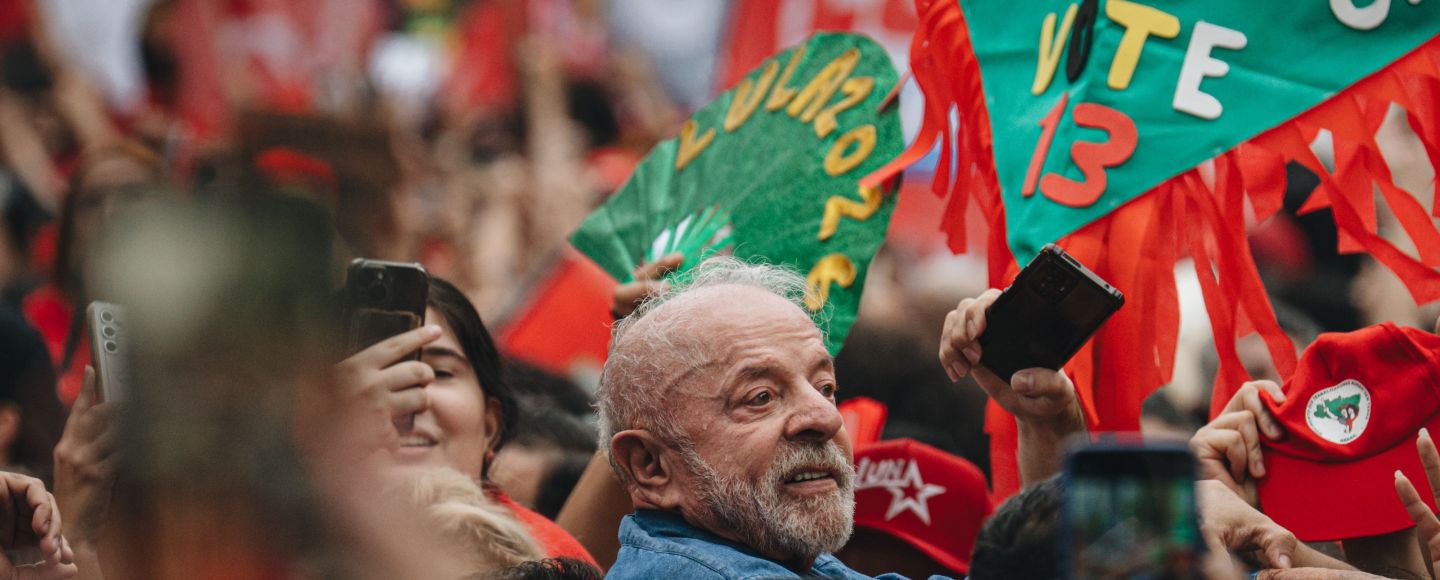
(Cover Photo: Anderson Alves / Pexels) President Luiz Inácio Lula da Silva greets supporters during a campaign rally.


0 comments on “Brazilian Elections: How Democracy Won the Battle Against Disinformation and Intervention”