
by Sneha Maria Tijo
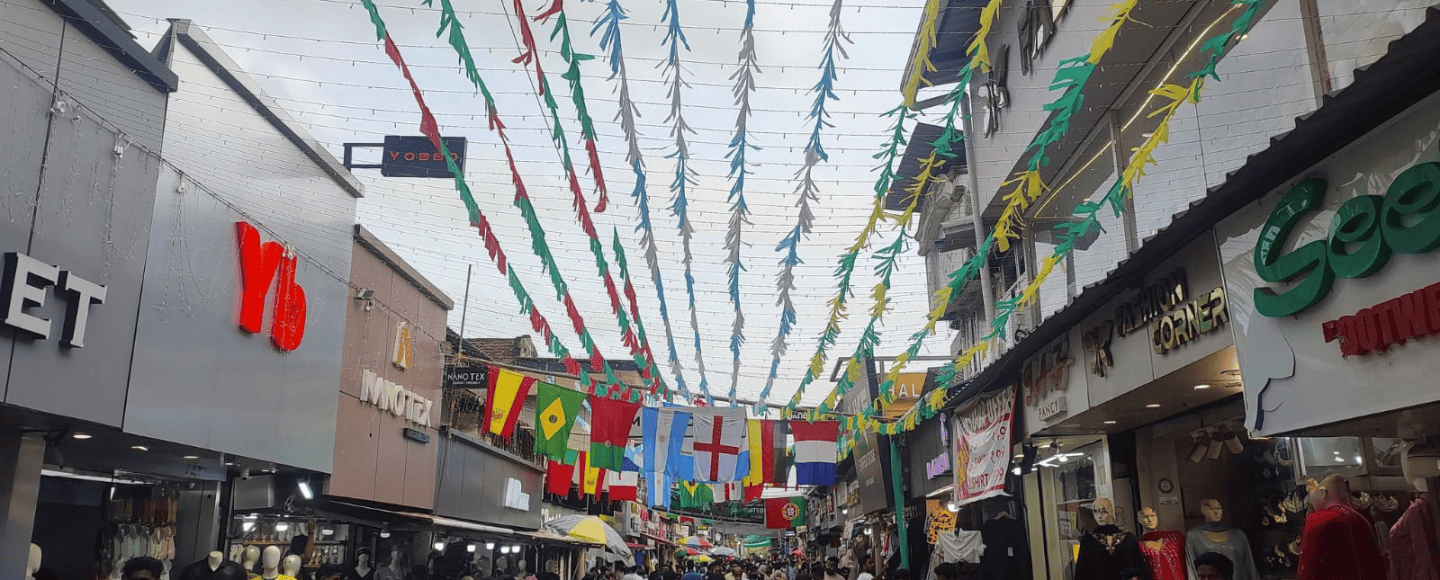
Every four years, Kerala, a narrow state on the south-western coast of India, drapes itself in the blue and white colors of the Argentinian flag. The passion is such that the most uninitiated will know who Messi and Maradona are, and banners and towering cut-outs of players are hoisted everywhere. Lately, there has been an effort to be more ecumenical, with the main streets carrying the flags of all forty-eight participating countries. But step into any shop, and you will overhear a debate about whom Scaloni intends to start against England, or whether Nico Paz is the next best thing ‘we’ have. These conversations cut across gender, and are spoken with an affection so proprietary that you might take ‘Nico’ or ‘Julián’ for the neighbours’ children, and not for players of a nation fifteen thousand kilometres away.
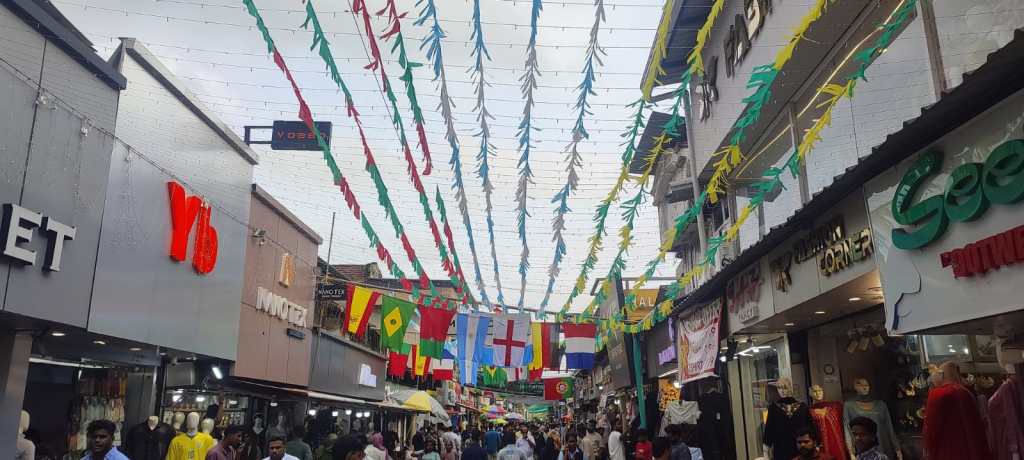
There are devotees of the game everywhere, people who rise in the small hours for the Premier League or follow the LaLiga, but very few places pour their allegiance onto the streets in plaster and paint, and fewer still do so on behalf of a country that is not theirs. Kerala shares the condition with West Bengal, with Bangladesh, and, in some areas, Pakistan.
The game itself arrived here in the luggage of the British. In the Malabar region, soldiers stationed in army camps played the game while locals watched, improvising their own balls from whatever materials they could find. In Bengal, meanwhile, the sport had taken root as early as the 1890s, with all major Indian clubs born in Kolkata. By 1911 a crowd of nearly fifty thousand was gathering at the Calcutta Football Grounds to watch the fledgling Mohun Bagan take on a team of British soldiers. – From the beginning, football in this part of the world was never merely a game, but a sanctioned form of scoring against the Empire. It was therefore natural that the first great national romance should be with Brazil. When Pelé’s side won the World Cup in 1958, the anti-colonial ripples of that victory were felt even in Kerala, and a dazzling, improvisatory football that was held by many to be inefficient seemed to prove that elegance might outwit order. Argentina’s win in 1978 hardly made a dent in the Malayali consciousness; it took eight more years and a man from Buenos Aires to do that.
Then came television. The 1986 World Cup in Mexico was telecast live in India, and since colour sets were then a rarity, whole neighbourhoods gathered in the one house that owned one. It was before such a screen that they watched Maradona score twice against England: first with that Hand of God. Maradona himself described the victory as revenge for the Falklands (Malvinas) humiliation, and for a subcontinent that had spent a long time on the receiving end of British condescension, the temptation to adopt the avenger was irresistible.
In Kerala, this sentiment fused with a politics that was already waiting for it. The state is one of the few places on earth where a communist government is still an ordinary part of the electoral furniture. Maradona wore his allegiances on his skin, with Che Guevara tattooed on his arm and Fidel Castro on his leg. It also did not hurt that Che and Messi were both born in Rosario. When Maradona died in November 2020, the state’s government declared two days of mourning, a gesture usually reserved for statesmen.
Kolkata too had a similar story. A city that has loved football since the nineteenth century does not need a foreign hero to teach it how to love, which is precisely why it picks one so critically. Pelé had already visited in 1977, but it was Maradona’s visit in 2008 that created a frenzy not seen since. He returned in 2017 to unveil a statue of himself holding the World Cup. The Kolkata Argentina Football Fan Club, the largest of many such clubs, gathers three hundred fans in a small park at a quarter to six in the morning. The same place, of course, saw the other side of this devotion in December 2025, when Messi’s tour of India began in Kolkata, and spectators broke through barricades and stormed the pitch after he left earlier than expected (the intensity of love is a poor guide to the competence of those who sell tickets to it).
Bangladesh, which has no communist government and no cult of Che, has found its own reasons, and they are probably the most interesting of all. The 1986 World Cup was the starting point. In the 1970s, Brazil were the favourites of the sports-loving young, and many of Brazil’s fans came from the richer, elite backgrounds, while Argentina became their counterpoint.
This year, Messi’s Argentina was no longer the underdog but the established order, which explains much of the bile that crowded social media this summer. And yet, on the night Argentina beat England in the semi-final, public grounds and beaches here found themselves flying the flag and singing the albiceleste song in tears of happiness. It says something about the stubbornness of an inherited loyalty.
Then came the loss, but fans in MetLife Stadium as well as the world chanted his name. The retirement announcement was another shock that the fans were bracing themselves for. On October 6th, white screens were hoisted again for public viewings; fans gathered around in the wee hours of the morning to see the God of the Game in that jersey for the final time.
Messi will not be playing in 2030. We will see in four years whether the faith and unbridled passion remain, and whether these streets will turn into Smurf-cities again in the next World Cups to come.


0 comments on “The Argentine Football Obsession in South Asia”