
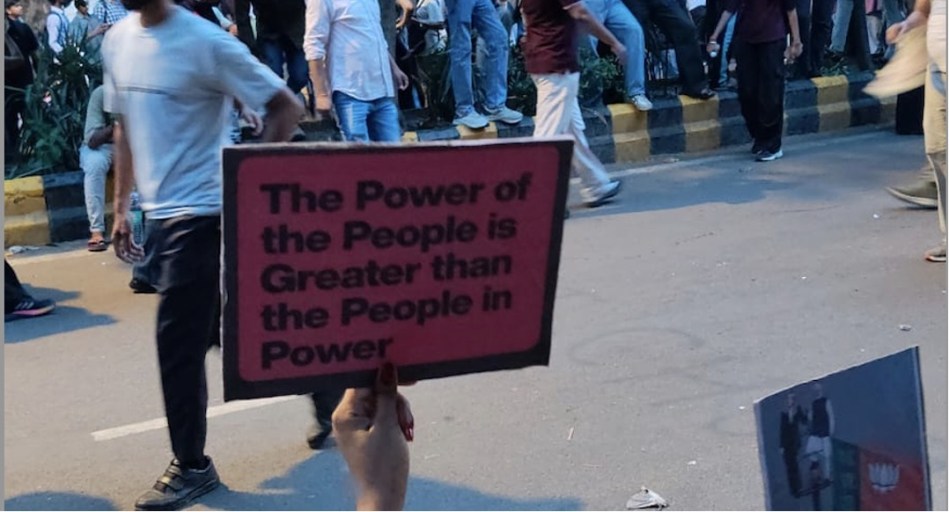
Image courtesy of Satvika Mahajan
by Francesca Polano
June 20th marked the start of a youth-led protest at Jantar Mantar, the designated site for demonstrations in central New Delhi. The protesters flooded the streets demanding accountability over alleged irregularities in India’s public examinations, including the leak of questions from the National Eligibility-cum-Entrance Test (NEET-UG), the entrance exam for undergraduate medical and dental programmes.
Behind their demands lay the frustration over what this exam represents for millions of Indian students and their families. Beyond a mere test sitting, it is also the gateway to a medical profession that could offer them greater financial security in the future.
Ultimately, the controversy deepened after the examination was cancelled and the candidates were required to sit again, disrupting the plans of students who had spent years preparing for the test. It also threatened the finances of countless low-income families, many of whom had gone into debt to fund the private coaching their children needed to prepare. At least 21 students were reported to have died by suicide in the aftermath, according to reports cited by the Cockroach Janta Party (CJP), which commemorated them during the protests and demanded compensation for their families.
An investigation into the alleged irregularities found that teachers and intermediaries linked to private coaching networks had shared exam questions with selected candidates. The allegations exposed the vulnerabilities of a system in which a single examination can determine access to one of India’s most coveted professions, while expensive private coaching has become an increasingly important part of preparing for it, undermining public education. For many low-income families, this preparation comes at a high cost, with many taking on debt to finance years of coaching in the hope that their children will secure a place in medical school and, ultimately, a more stable future.
These events wounded a generation of young people, awakening a growing frustration over the government’s lack of accountability and the scarcity of spaces where they could openly discuss the issues harming younger generations. Behind them lies a country where nearly 40% of graduates aged 15 to 25 are unemployed, according to Azim Premji University’s 2026 State of Working India report, and where, among graduates overall, only 6.7% hold permanent salaried jobs.
Mobilised by the youth-led Cockroach Janta Party (CJP), on July 20th, thousands of young people gathered at the same site, marching to Parliament and calling for accountability, education reform, and the resignation of Education Minister Dharmendra Pradhan. The march, however, was met by a police response that included the use of force, escalating the confrontation between the protesters and the authorities.
Satvika Mahajan, a student at the Institute, and Samridhi Tewari, a journalist with The Print who covered the protests from their earliest days, agreed that the turning point for the protest came when police responded to a hunger strike by climate activist Sonam Wangchuk. What police described as an intervention to provide him medical care, protesters called a forcible “kidnapping” meant to weaken the movement. According to both sources, it was this moment that validated the protest in the eyes of a wider public and drew a surge of new demonstrators to Jantar Mantar.
The scale of the protest was staggering. Samridhi Tewari, who was on the ground, estimated that around 10,000 people had gathered at the site, although other sources put the crowd at more than 50,000. The situation was complicated by an internet shutdown in the area, which forced communications to rely on text messages and phone calls and led some protesters to move elsewhere simply to regain access to the internet.
Ultimately, Pradhan resigned on July 25th, handing the CJP a major victory. The concession came after several pressures converged: the protests had sustained their momentum for weeks, spread beyond New Delhi, attracted thousands of young people and families, and transformed a technical examination scandal into a broader crisis of public trust. Digital mobilisation amplified the movement, while the police response to the protest brought it national attention. As negotiations failed to contain the unrest, Modi’s government was faced with the prospect that the protests would continue to grow.
Pradhan’s resignation therefore represented much more than a change in government. In a political system where Prime Minister Narendra Modi had cultivated an image of strength and had generally resisted conceding to political pressures, it was a rare and consequential sign. It showed that a youth-led movement without the backing of an established political party could force the government to meet its demands.
Yet what had started as a protest over education reform gradually became a channel for broader discontent among young Indians facing intense educational competition and scarce professional opportunities. The CJP took its name from a remark by India’s Chief Justice that the group interpreted as comparing unemployed youth to cockroaches, an insult the party reappropriated to demand accountability from a government that has held power for over a decade and that, in their view, has failed to fulfil many of its promises on employment and education.
The demand over the challenges India faces today drew in far more people from society, beyond just students. Both Samridhi and Satvika described a crowd that was far more diverse than the movement’s origins might have suggested. Parents, grandparents, first-time protesters who had never set foot in Delhi, and people from remote villages without access to the internet were all voicing grievances over corruption, infrastructure, and unemployment, concerns that extended far beyond the original exam leak.
The vestiges left by the events from July 20th onward not only revealed the brutal actions of the Indian government and its police, but also the resounding force with which young Indians fought, peacefully and unprecedentedly, for a better future. “A particular moment that struck me from the protests was when I saw such young people. At the end of the day, they were 18-year-olds getting hit by the police by simply asking for a better education system,” said Satvika. Police violence escalated further after July 20th. Tear gas shells and pellet guns fired by the Rapid Action Force, a paramilitary unit, left protesters, including women and children, injured and detained, according to Samridhi’s account. “Why would your police unit beat us up like that?” Samridhi recalled asking. “That is the day I realized none of those people were going to go back home.”
Satvika also explained her own decision to join was rooted in something larger than the exam scandal itself: “I felt like education is such an important topic, and I saw the movement transform into something much bigger than what it started, and I want to be part of that.” In a particular moment during the protest, Samridhi met two young boys from a remote village in Chhapra. She asked them what their motivation was to be part of the protest, and they said: “We want to fight for the rights of our people, our generation.” The moment stuck with her. She recalls that at their age, she “did not have the courage to question or the awareness to know what is going on.” To her, these two kids weren’t children anymore; they were responsible citizens, seeking answers from the government at such a young age.
The crisis of trust that sparked the movement extended into public education more broadly. As Satvika put it, “I think the education system in India needs reform from the bottom-up. Most public schools are not able to offer teachers or basic items like blackboards, chairs, or tables.” With 65% of India’s population under 35, and public education failing to expand at the pace of demographic growth, families are pushed toward private alternatives, standardized exams fuel a coaching industry, and a university degree offers little guarantee of stable work.
Both interviewees noted the movement’s digital character, with memes, satire, and viral videos sustaining momentum even under an information blackout, and its unusual breadth. “There were people across communities, across sectors,” Samridhi recalled, “students, family members, activist groups… for the entire month these people were protesting on the streets, and they became good friends.” Satvika similarly noted different classes and castes mixing at the protest site for the first time. However, this digitalization also existed in parallel to, in Satvika’s words: “a lot of shadow banning and curtailing of the content. I have 1000 followers, and I was posting some stories every day, and I saw my Instagram views, which are usually 700 or 800, go down to 150 views, which was very unusual.”
Looking ahead, both sources cautioned against reading the resignation as a resolution of the conflict. “Resignation is not going to change the system,” Samridhi said. “What is going to change the system is accountability.” Others called for decentralized education investment, “managed by local communities rather than by bureaucracies,” giving students a voice in their own learning, paired with economic policy capable of generating jobs that meet young people’s needs.
The demonstrations, and the government’s response to them, revealed the contested state of Indian democracy. As Samridhi put it, “protests are vital; people should be allowed to question the government, because they are the ones voting for you.” It is in these pockets of resistance that the flame of democracy is rekindled, and through these protests, a new generation placed itself at the centre of India’s democratic conversation. Many of the demonstrators were students who had never previously taken part in political action, yet they confronted the state and demanded accountability for the conditions that are shaping their futures. “The protests mean that we are going to hold the government accountable,” Satvika said, “and what happens next is going to determine how it changes the social fabric of the country”.
The protests cannot, by themselves, resolve India’s education or employment crises, nor can the resignation of a single minister repair an entire system. Yet, as Satvika explained, the mobilisation showed that young people who had come to believe that “the system cannot change” could still make their grievances impossible to ignore.
The mobilisation showed that India’s young citizens are unwilling to remain passive recipients of political promises. In a country grappling with deep challenges relating to education and high youth unemployment, new generations are becoming increasingly unwilling to accept the silence, inaction, and lack of accountability of those in power.


0 comments on “At Jantar Mantar, A Triumph in Government Oversight for India’s Youth”