
By Gregory Wagner
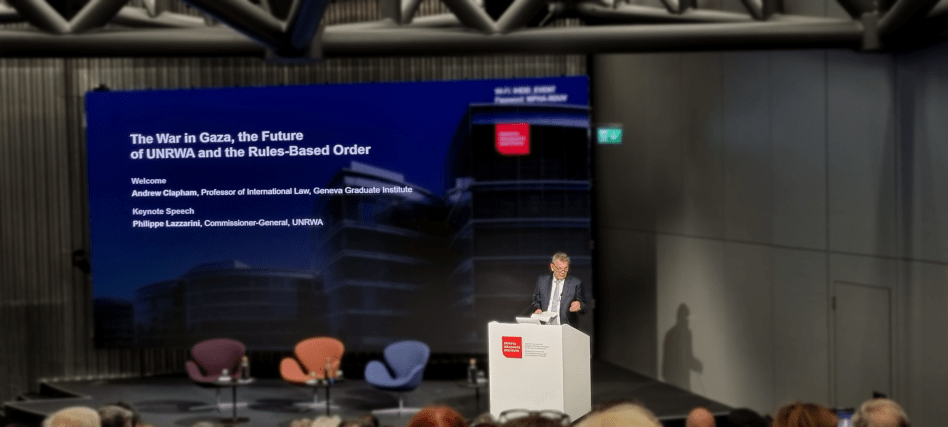
Tuesday, March 24th, Philippe Lazzarini, the Commissioner General of UNRWA, spoke at the Graduate Institute in what amounted to a farewell address. This was to be one of his final appearances in this role before his resignation at the end of the month, marking an end to his six year tenure. In front of a full Ivan Pictet auditorium, the Swiss diplomat offered an unflinching account of the war in Gaza, the systematic campaign to destroy the agency he led, and what he sees as a collapse of political will to defend the rules-based international order.
He opened with a paradox that set the scene for everything that followed: before October 7th 2023, the broader public were not familiar with UNRWA despite its scale and reach– employing nearly 30,000 people and providing education, healthcare, and social services to millions of Palestinian refugees in Gaza, the West Bank, Lebanon, Syria, and Jordan. The war has changed that, he noted. Since then, UNRWA has, as he put it, “become a bellwether for the changes sweeping the Middle East and the multilateral system that has existed since the end of the Second World War.”
His account was as much personal as it was political. He described being the first high-ranking UN representative to visit Gaza after the war began. When he arrived there in early November 2023, he found a “post-apocalyptic wasteland.”
In an UNRWA school in Rafah, where thousands of displaced civilians had sought refuge, he met a girl about the same age as his youngest daughter, who begged him for water and bread. “The despair in her eyes still haunts me,” he said. Israel’s siege of Gaza in the successive years was systematic, intentionally targeting schools and healthcare facilities. Food was weaponised to the extent that a man-made famine was declared for more than a half a million people. Food distribution points run by the notorious Gaza Humanitarian Foundation were “death traps” where nearly 2,000 starving people were killed by Israeli soldiers firing into the crowd. Finally, in October 2025, a ceasefire was announced. A breakthrough, but one which exists “in name only.” Over 650 Gazans have been killed by Israeli air strikes since it came into effect.
Lazzarini alleged that Israel was waging a deliberate and coordinated campaign against UNRWA. For decades, Israel had regarded the agency as a “necessary evil,” disagreeing with its mandate but recognising its stabilising function. After October 7, it became an “unnecessary evil,” and its elimination an objective of Israeli actions. Over 400 UNRWA-workers have been killed, some in the field and others at home with their families. The agency’s headquarters in East Jerusalem were stormed, looted. and set on fire. The Israeli military replaced the UN flag with the Israeli one. The deputy mayor of Jerusalem called for UNRWA personnel to be “annihilated.” Lazzarini drew a pointed conclusion: “If it can happen to a UN agency, it can happen to any embassy of any member state.”
Lazzarini also criticised the international community’s failure to respond. Violations of international law are nothing new, he argued, “but what is new is the sense of complete impunity, that rules hold no sway, even if this leads to a new form of barbarism.” The Geneva Conventions were agreed over 75 years ago to protect civilians in conflicts, but governments that present themselves as defenders of the international order apply it selectively, he said. Heads of state and government do not mount substantive resistance or protest to Israeli actions,- capitulating instead to “economic or military bullying.” In an interview with RTS on March 23rd he forcefully criticized the position of his own country. “What pained me most was that Switzerland was absent when it came to defending international law.”
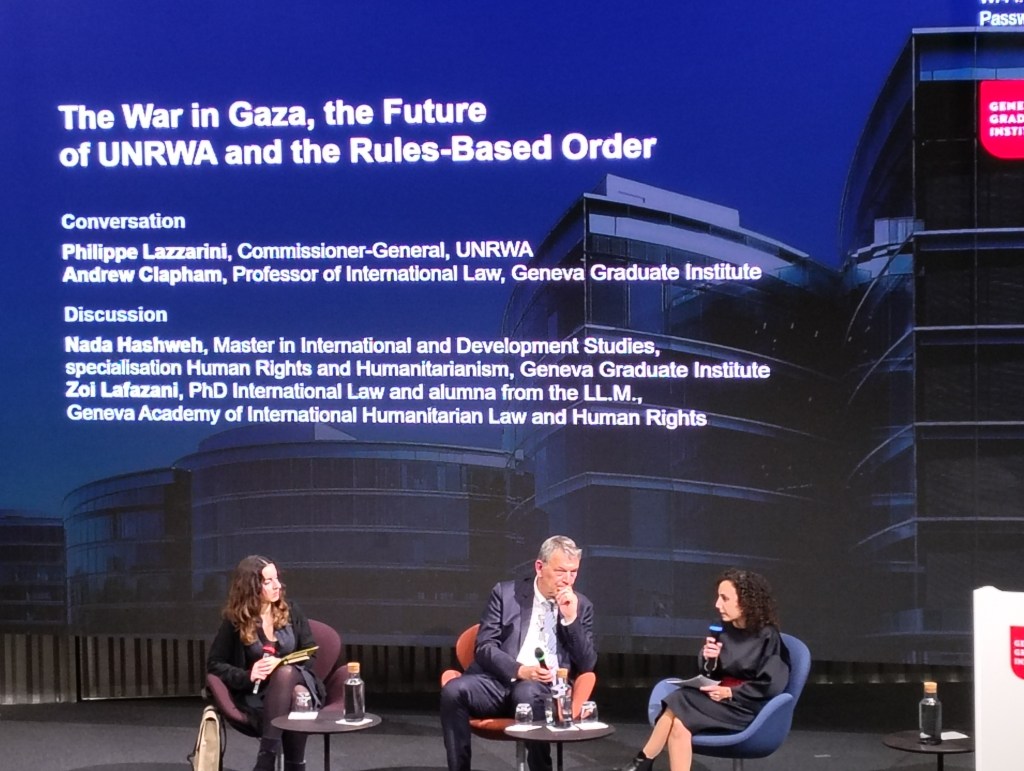
In the ensuing discussion with Professor of International Law, Andrew Clapham, and later with two students from the Institute, the analysis became even clearer. No ruling by the International Court of Justice had been heeded. No trade sanctions had been imposed on Israel. The arrest warrant against Netanyahu had not restricted his freedom of movement. “I haven’t seen a single country that has really stood up for itself,” he said. “We must not make ourselves complicit.” He closed his formal remarks by quoting Desmond Tutu–”To be silent in the face of oppression is to choose the side of the oppressor”–and by acknowledging that speaking plainly has come at professional and personal cost throughout his tenure. He appeared untroubled by this. “To be vocal is a choice,” he said, “and, in my view, a duty.”
Lazzarini hands over to the current UN special coordinator on improving UN response to sexual exploitation and abuse, Christian Saunders, on April 1st, who will act as Commissioner-General until further notice, according to UNRWA. He has also announced that he plans to write a book about his past years at the agency.
 The Graduate Press - La Gazette de la Paix
0 comments on ““Being Vocal Is a Duty”: The war in Gaza, the future of UNRWA and the rules-based order with commissioner-general, Philippe Lazzarini”