
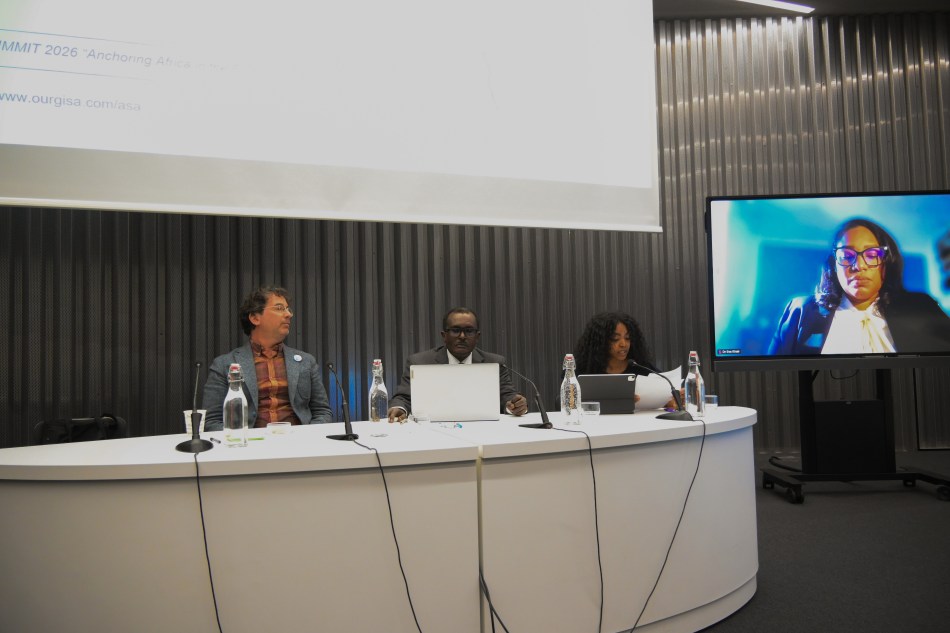
The panelists from left to right: Roman Deckert, Abdelbagi Jibril, Esra Alfadil, and Eva Khair
By Laura Minnetian
On March 26, the Afrique Students’ Association (ASA) at the Graduate Institute Geneva (IHEID) hosted the African Summit titled “Anchoring Africa in the Present: Where Vision Meets Momentum”. This article reports solely on the first panel held on “Sudan in Context: Colonial Legacies, Global Discourse, and Modern Conflict”, moderated by Esra Alfadil, an LL.M. student at IHEID.
Before handing the word over to the panelists, hosts Alexis Akodjenou and Samira Faria, both MA students at IHEID, emphasized that the aim of the summit was to anchor discussions on Africa in the present rather than in the past or in the future. The panel featured three speakers: Abdelbagi Jibril, Founder of the Swiss-based Sudan Knowledge Centre and the Main Representative of the African Centre for Democracy and Human Rights Studies to the UN; Dr. Eva Khair, founder of #Women4Sudan, a global solidarity campaign; and Roman Deckert, an independent analyst and publicist with a focus on contemporary and historical Sudan since 1997. Esra opened the panel by asking:
“What is the most critical misconception of Sudan today and its ongoing conflict, and why does it matter?”
Eva Khair commences by contending that the narrative of a civil war is the most common misconception of the conflict in Sudan: “It is not a civil war but a state attacking its civilians to counter the revolution of Omar al-Bashir’s 30-year dictatorship”. Framing it as a civil war, she explains, results in the disinterest of people, viewing it as another “tribal conflict in Africa”.
Deckert echoed this statement, further elaborating on the involvement of Western and neighboring states. By providing specific examples, he illustrated how international actions contributed to the conflict, such as Switzerland’s purchase of Sudanese oil and gold, as well as the sale of Israeli surveillance technology to the Rapid Support Forces (RSF) in Sudan. He argued that the conflict has not been caused by ethnicity, as the “tribal” narrative suggests, and it is therefore important to look at the global dimensions and existing hypocrisy in many Western states in order to break the cycle. “It is not a forgotten war, but deliberately ignored”, he asserted.
For Abdelbagi Jibril, the most common misconception lies in the lack of understanding of the origins of Sudan’s long-lasting conflict. To grasp the full picture, he started unfolding the impact of colonial legacies, which misused the ethnic duality between people who identify as Arab or African, leaving discrimination and disputes behind. The ongoing conflict in Sudan, as he voices, is one about identity and cultural orientation. A conflict that the Sudanese people are competent in solving, he emphasized.
Dr. Khair, “Why has Sudan remained relatively marginal in global discourse, and how has the way it is framed internationally shaped responses to the conflict?”
“To ‘forget’ or rather to ignore the war is a political decision”, Khair argued. For instance, the United Kingdom is an important penholder in the Human Rights Council, but they have not used its full diplomatic arsenal to stop the war in Sudan. She continued by explaining that media discourses are mainly influenced by politicians, who heavily emphasize the ethnic aspect of it, and therefore are responsible for the marginalization. She exemplified this through the difference in media coverage of the Ukraine war compared to Sudan: Ukraine being a clear priority. Another explanation, as she mentions, is the current multitude of wars in Ukraine and Gaza, occupying the UN’s involvement and media attention.
Mr. Deckert, “Which colonial-era structures or decisions still shape Sudan’s political and social fractures today, and how do they continue to influence the current conflict?”
Deckert began by explaining the colonial issues and dependencies that Sudan is facing as a result of its history of colonial legacies. These began with the Ottoman-Egyptian rule (1820-1885), and were followed by the Anglo-Egyptian (1899-1955), which was a de-facto British legacy. Both regimes robbed Sudan of its human and economic resources, especially gold. The effects of this can still be seen today, as some of the elite networks established during the British legacy are still in place. However, Deckert claims that not everything can be blamed on colonial history, as Sudan has been independent for 70 years. He highlights several issues, such as internal racism, toxic masculinity, patriarchy, and the fact that “Sudan is an army with a state”.
Dr. Khair raised her hand to highlight that the Sudanese youth had already tried to solve the problems in their country during the protests 6 years ago. These protests were hampered by the international community, which insisted on the need for a military to rule the country. Therefore, as she stated, it is very difficult to extract Sudanese responsibility from international intervention. She also countered the arguments raised about toxic masculinity and ethnic divisions, stating that these are not solely issues in Sudan; they exist in every country. She stressed that it is important to always contrast the narrative with wealthy Western states. “Sudan is always striving for better and equity, but it keeps getting bashed down.”
Mr. Jibril,“If we look at Sudan today, what are the most critical developments that the international community is overlooking right now?”
Jibril shared a slightly contradictory perspective to Deckert and Khair, emphasizing that Sudan is currently experiencing an internal war. He pointed out that while this conflict is interconnected with the broader community, it is the Sudanese people who initiated the violence and thus bear responsibility for its resolution. He described an emotional division among the Sudanese, which influences the actions they take, and contributes to the dire catastrophic humanitarian situation. “People are dying almost every week; people are displaced and in need of food”, he stated. He acknowledged the international community for not remaining silent and for continuing to organize conferences and committing themselves to support humanitarian needs in Sudan. However, even though there is plenty of life-saving material given, he stressed that access is denied by the Sudanese army: “The humanitarian situation is man-made”. At the end of his elaborations, Jibril appeared emotionally torn and concluded on a hopeless note: “I don’t count on the intervention of the international community. Who is going to send their troops? No one. We should really go directly to the roots of the problem. We have to diagnose the illness and what remedy needs to be done by whom.”
The end of the conference left the room feeling heavy. Many concerns and emotions were shared, but instead of letting these feelings completely take over, the speakers explicitly expressed their gratitude towards those who had attended in support of Sudan. Events like this one, sponsored by Hamada Drinks and the Organisation de la Francophonie, keep the discussion on Sudan ongoing and demonstrate solidarity and interest. The speakers called for solidarity with Sudanese students, whose visas have been cancelled in the UK: “Only the Sudanese can save Sudan, but we can assist and support them, by at least not being complicit with the perpetrators”.
 The Graduate Press - La Gazette de la Paix
0 comments on “Sudan: “Not Forgotten, but Deliberately Ignored””