
By Melisa Kisacik
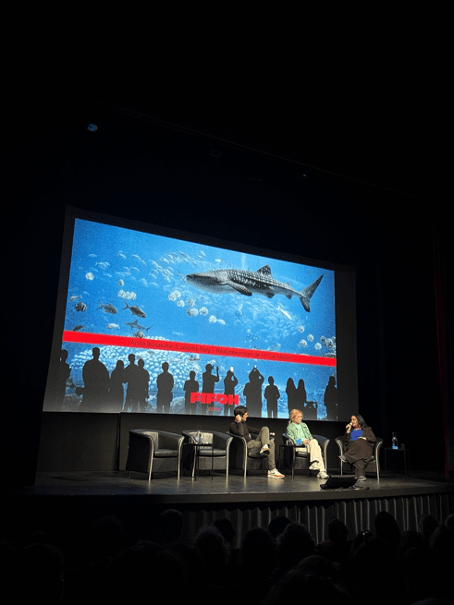
Last week, I attended several screenings at the International Film Festival and Forum on Human Rights (FIFDH), a festival that brings together documentaries exploring political change and human rights around the world. Two films in particular stayed with me: Meloni Rising and The Librarian. Although the films focus on very different contexts, the rise of the far right in Europe and the erosion of democratic norms in the United States, watching them back-to-back revealed an unexpected connection. In both films, women play a central role in promoting conservative political agendas. In one case, this appears at the highest level of national power through the political rise of Giorgia Meloni. In the other, it takes shape through grassroots activism led by groups such as Moms for Liberty, a U.S. parent’s organization active in school board politics and campaigns around education and book bans. What makes this particularly striking is that these women occupy positions of influence partly thanks to decades of feminist struggles that expanded women’s political participation, yet the policies and movements they support are often criticized for challenging or rolling back some of those same rights.
One element that particularly struck me in Meloni Rising was the attention given to Giorgia Meloni’s political performance, her gestures, tone, and style of speech. Historians interviewed in the documentary point out how her way of addressing crowds draws on a long Italian tradition of political theatre, echoing the exaggerated gestures and dramatic delivery associated with the commedia dell’arte. At the same time, the film suggests that these performative elements also recall the rhetorical style of Benito Mussolini, whose speeches relied heavily on strong gestures, rhythmic repetition, and highly emotional appeals to national identity. By highlighting these stylistic continuities, the documentary shows how political communication can draw on historical and cultural repertoires that make certain messages feel both familiar and powerful to audiences. The film asks a question that resonates far beyond Italy: how can a continent still shaped by the memory of World War II witness the normalization of far-right rhetoric and policies?
Meloni’s political identity is often framed through her gender and her role as a mother. Her speeches frequently emphasize traditional values and national identity, presenting her leadership as both modern, breaking the glass ceiling of Italian politics, and rooted in a conservative vision of family and society. This dual narrative also helps explain the paradox at the heart of the film: rather than rejecting women’s emancipation outright, Meloni reframes it. Her position of power becomes proof that equality has been achieved, while the focus shifts toward defending “natural” roles, family structures, and national identity. In this sense, feminist gains are not denied but repurposed to legitimize a more conservative political project.
The Librarian shifts the focus to the United States, examining the broader political climate surrounding the presidency of Donald Trump and the intensification of cultural and political conflicts across the country. While national politics provide the backdrop, the film shows how these tensions are implemented at the local level, in schools, libraries, and school boards. Grassroots movements led by parent’s organizations, including Moms for Liberty, have become influential actors in debates over education, censorship, and cultural identity.
What is particularly striking is not only their influence, but their methods. These groups rely on highly organized local action: attending school board meetings, challenging curricula, and pushing for the removal of books that address race, gender, or sexuality. Their rhetoric mirrors, in a different register, the strategies seen in Meloni Rising. By mobilizing maternal identity and the language of protection, they frame their actions as safeguarding children and defending freedom. Yet this framing often justifies restricting access to information and limiting what can be discussed in public education. As in Meloni’s case, the language of rights and protection is used to support policies that critics argue narrow those same rights.
Seen together, the two documentaries reveal a paradox that complicates simple narratives about gender and political progress. The increased presence of women in political life is undeniably one of the major achievements of decades of feminist activism. Yet, representation alone does not guarantee the advancement of feminist policies. Women, like men, occupy diverse ideological positions, and some have become leading figures in movements that promote socially conservative agendas. Agendas that draw on a hierarchical understanding of freedom, in which certain rights such as religious liberty, parental authority or national sovereignty take precedence over others. Moreover, their own access to power is often framed as evidence that equality has already been achieved and that women’s emancipation no longer requires further structural expansion of rights. As a result, the policies they support are not perceived as undermining feminist gains, but as correcting what they view as excesses of liberal progressivism.
In both films, access to power is not used to expand rights, but to redefine them, often in more restrictive terms. Rather than offering easy answers, they encourage viewers to reflect on the complexity of contemporary political dynamics. Watching these films at FIFDH was a reminder that debates about democracy and human rights are rarely straightforward, and that the struggle over rights today is not only about who holds power, but also about how that power is used to reshape their meaning.
 The Graduate Press - La Gazette de la Paix
0 comments on “Representation Isn’t Enough: What Two FIFDH Films Reveal About Women and Power”