
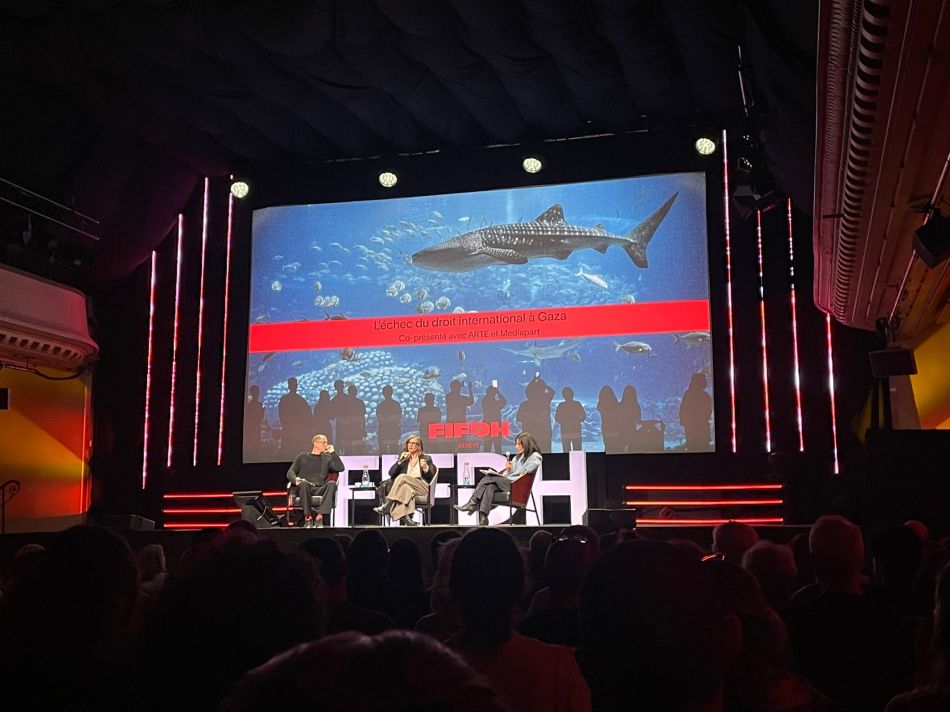
On the 13th of March, in the Grande Salle of the Espace Pitoëff on Rue de Carouge, the Geneva Film Festival and International Human Rights Forum (FIFDH) screened “Disunited Nations,” a documentary by Christophe Cotteret. The documentary critically examines the role of international law in the ongoing Gaza genocide, drawing on the analysis of Francesca Albanese, UN Special Rapporteur on human rights in the Palestinian Territories. The event consisted of two parts: the first was the screening of the documentary, and the second was a discussion moderated by journalist Rachida El Azzouzi, featuring Director Cotteret and Albanese.
Contrary to what the title might suggest, the documentary is not about the UN or diplomatic negotiations regarding Palestine since October 2023, nor is it primarily about Francesca Albanese as special rapporteur. Instead, it focuses entirely on Gaza. The approach appears strategic; rather than examine the failure of international law through negotiations or courts, it highlights the perspective of those bearing the brunt of this failure.
The documentary highlights that Gaza, understood both through its people and its political significance, extends far beyond its physical borders. It shows how Palestinians who connect with Albanese’s work invite her to share in their traditions even while far from their homeland. It also portrays her ongoing relationships with Palestinian activists, as well as her interactions with a small group of diplomats and politicians who, despite having no direct ties to Palestine, recognize this injustice as part of a wider unjust global system.
The mechanisms of the genocide in Palestine are not confined to Gaza or the restricted territories; they signifie a silent endorsement of neo-colonialism, where international law and diplomacy are considered secondary. Albanese’s role and findings continue to prove inconvenient to those who believe diplomacy should not confront facts but remain strategically rooted in peaceful dialogue.
The documentary highlights how numerous diplomatic meetings with Albanese have been abruptly cancelled just minutes before, out of fear of controversial outcomes or discomfort. Germany’s role in the film is also noteworthy. When Albanese visited the country, there were plans to arrest her for speaking at a major Berlin university. While, in a scene of the documentary, she jokes about her fears of being arrested, it seems clear that this incident underscores a broader issue: the rise of fascism across Europe, where evidence of genocide is feared and the recognition of such crimes is overshadowed by unsubstantiated allegations of antisemitism.
This was made very explicit in the second part of the event, the discussion, where the Palestine genocide revealed profound dysfunctions. The UN, originally designed for humanitarian aid, can no longer provide it effectively. Humanity seemed to end when the act of delivering aid to a dying population became controversial. Furthermore, even though international law exists and is more clearly articulated than ever, its failure has been laid bare.
As Albanese detailed in her last report, “From the economy of the occupation to the economy of a genocide,” our economic system is intertwined with conflicting interests, with Israel at its centre. For example, Albanese notes that the EU remains Israel’s strongest commercial partner. Palestinians, once again, are victims of this systemic failure, but they also have the power to redefine it. Albanese broadly highlighted how their response is to develop an ethical, circular economy to support their freedom project. She talked about an “economy of resistance” where local, sustainable productions are favoured in order to reduce dependence on Israeli goods.
Director Cotteret explained that the documentary aims to reflect upon institutions, talking about their power and shortcomings. “How can we rethink cooperation?” he posed. The focus should not be on spreading misinformation about Albanese herself, but rather on what is happening and how change can be effected.
“the political system that has oppressed and has convinced the oppressed that they were not.” – Francesca Albanese
Furthermore, the widespread mobilisation of the public demonstrates something else. While international law’s failure is central to the discussion, Albanese emphasised that, even in its shortcomings, international law has never been so widely acknowledged. She concludes that the failure lies not in the law itself but in “the political system that has oppressed and has convinced the oppressed that they were not.” Ongoing global debates and trials offer hope for justice in Palestine. “International law is the last instrument in our hands for peace,” she concluded.
 The Graduate Press - La Gazette de la Paix
0 comments on “Disunited Nations: How Gaza Exposed a Broken System”