
by Sabrina Casale
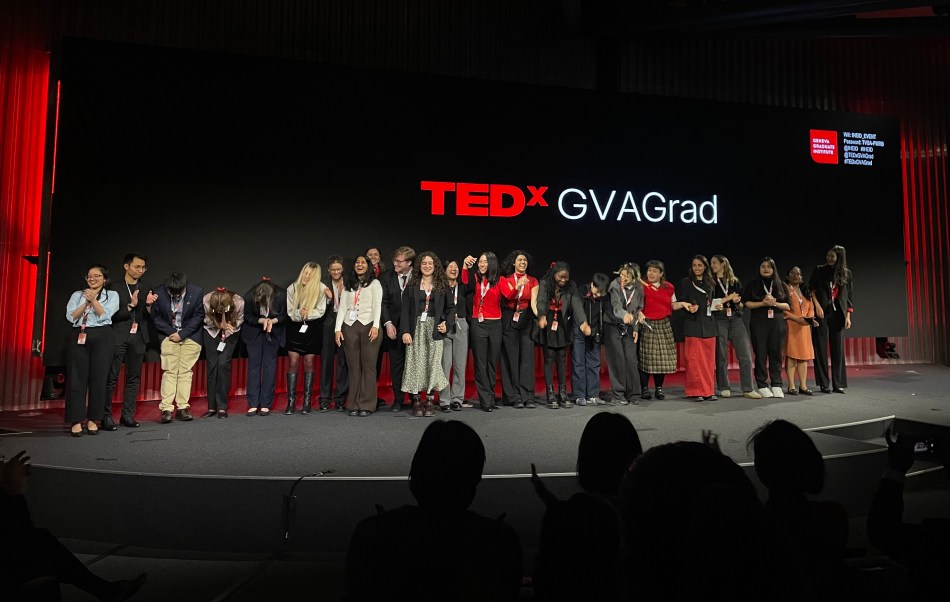
On the 14th of March, Maison de la Paix hosted the TEDxGVAGrad. The conference featured sixteen speakers, the roster of which included students, guest speakers, and performances all delivering presentations under the theme “May you live in interesting times.” A phrase, often used to define our current era, was finally stepping into the spotlight to define itself. So, each guest speaker presented their interpretation of the theme. The event was divided into four sessions, each differentiated by a brief 10-minute-break.
Mark Moser opened the talks at the event. He is a lecturer, consultant and bridge-builder working in intercultural communication between international organizations and academic institutions. He spoke about the superpower of radical acceptance, emphasising the importance of talking to oneself as one would to a beloved friend. In times demanding resistance to global tensions, Moser pushed for an approach rooted in acceptance; that can be stronger than one based on hatred.
Following Moser’s speech, the Brazilian first-year MINT student Vesper Junqueira expanded the concept of development from a different angle. They raised the question: what does it really mean for a country to develop, and why do we often picture developing nations as being backward and lagging behind? What if, instead of development, we focus on community engagement?
In the second session, Wahid Majrooh, former Minister of Public Health in Afghanistan and the youngest member of the cabinet when the Taliban took over Kabul, introduced a leadership perspective to this theme of engagement. After describing the horrors experienced during the Taliban’s takeover, he explained why he chose not to flee his homeland despite its dire circumstances, saying, “Crisis doesn’t create leaders — it reveals them.” However, the choice of staying was not easy for Wahid Majrooh as his wife and child were, on the other hand, fleeing the country. Even though a leader’s duty is akin to that of a father wanting to be there for his child, he explained how the need to support the nation became, for him, paramount. In his view, interesting times mean supporting the community, even if through crises.
Closing the session, there was another student speaker and President of the Peacebuilding Initiative: Olivia Bornyi. Olivia also explored leadership and the paradox faced by peacebuilders: feeling small while striving to create a better world. Her speech was inspiring, reminding the audience that no matter how powerless we may sometimes feel, what truly matters is that we never give up, lose hope, and continue to raise our voices.
In the third session, other speakers shared their definitions of interesting times. Morgane Bascle highlighted that Europe’s growth challenge is not merely economic. During her travels and work experiences globally, she noticed something often left out of books: optimism. In many countries beyond the Western perspective, she noticed how optimism was making a tangible difference. By contrast, she argued that many citizens in Europe have lost the excitement of building something new. According to her, the most significant result an expanding economy can create is a positive mindset that sees failures as manageable.
Linking to what Moser had previously highlighted, Vivian Ejezie and Damien O’Brien offered separate interventions that ultimately conveyed a similar message: the importance of mental health, slowing down, being present, and remaining human. Vivian Ejezie, a communications professional focusing on gender, media, and human rights, and Damien O’Brien, founder of The Mental Health Association Switzerland and the Coffee Foundation, a global mental health movement, both emphasized the need for greater compassion and awareness in our daily lives. Their presence, together with Moser’s, brought a gentle and heartwarming touch to the often cold surroundings of the Maison de la Paix. They left the audience with an important question: how can we allow ourselves to slow down, speak openly about mental health, and build communities rooted in care and connection rather than mere utility?
These insights were echoed also in the fourth session, featuring Leonilda Renaldo, Gargi Manek, and Elena Servettaz. Leonilda Renaldo, coach for aspiring leaders, shared her personal story, describing how her mother, an immigrant Spanish-speaking woman in an English-speaking society, used her from a young age as her own “AI” for document translation and writing. Therefore, in her talk, she talked about AI not in the modern sense, but juxtaposing the artificial nature of modern AI against her own conception of “authentic intelligence.” Although authenticity in the workplace can seem daunting in our productivity-driven society, Leonilda reminded us that answers and abilities often reside within us and that we do not need external AI tools to be our best selves.
Gargi Manek extended Renaldo’s theme, bringing on stage the courage to stand still, to take some time to rest. Gargi drew upon her personal experience, often confusing ambition with inevitable burnout. However, her talk emphasised that a constant ringing phone and a busy schedule do not equate to success. From individual experience, she moved to a concrete, public example, criticizing the trend of COP meetings appearing more about participation than actual outcomes. When being visible often seems more important than delivering tangible results, productive dialogues and agreements fade into the background. Sometimes, she emphasized, the real courage lies in stopping and observing.
Finally, Elena Servettaz, a Franco-Russian investigative journalist, chose not to speak about others’ stories but instead revealed her own. She described how she felt when her two-month-old child was in intensive care, emphasizing that “interesting times” can be deeply personal as well as global. One can be facing their worst nightmare while the world continues its relentless spin. She stressed that such moments often arrive quietly, seeming both invisible and unfair. Revolutions do not always announce themselves loudly; sometimes, they emerge subtly through experiences of injustice.
The TEDxGVAGrad talks were complemented by a range of artistic performances between sessions. The musicians Francesco Fermia and Pietro Pasinato presented a guitar-and-flute performance, while the student Vrinda Kapoor sang about revolution with “What’s Going On?” The Swiss flow artist Jonah Andersen brightened the session with his light puppets, and the CERN Dramatic Arts Club provided comic relief through improvisational performances. The event concluded with Bahar Sharifi, an Iranian student in anthropology and sociology, who took the stage with her Tar, a traditional Persian instrument.
Undoubtedly, interesting times are here, reflected in not only global affairs but in our lives. However, what this event demonstrated was even more profound: compelling stories come first and having the courage to bring one’s vulnerabilities into the room is essential. Without understanding our backgrounds, we struggle to understand the world. Listening to others’ stories and drawing inspiration from them has never felt more important.
 The Graduate Press - La Gazette de la Paix
0 comments on “TEDxGVAGrad: Stories for Interesting Times”