
By GISA Vice-President for PhDs and AdA Board
“Living below the poverty line has meant being unable to secure suitable housing… I have been unable to fill medical prescriptions and foregone needed treatment because of the cost.”
[A PhD Researcher responded to the Survey on the PhD Reform.]
What’s been happening?
Since 2022 (at least), PhD researchers at IHEID have repeatedly expressed concerns regarding their continued precarious working conditions. In everyday discourse, the Institute infantilises PhD researchers by contractually categorising them as ‘students’ rather than ‘workers’ despite their substantial contribution to the Institute’s teaching, research output, and institutional reputation. This is particularly counterintuitive given the Institute’s collaboration with the International Labour Organisation (ILO) advancing the Global Coalition for Social Justice, which advocates for decent work for all. Moreover, this framing obscures the real academic labour performed by PhD researchers and can be seen as a moral abrogation of their rights. If James C. Scott was doing research today, perhaps he would have written, The Moral Economy of PhDs (instead of peasants).
The constant precarity also has a significant impact on wellbeing and mental health, as well as on the quality of research and teaching—what does ‘academic freedom’ mean to the institute if PhD researchers cannot even afford to pay their rent?
Petition: Towards a Fairer IHEID for PhD Researchers
In this regard, on 10th February 2025, IHEID PhD researchers sent a petition to the Foundation Board and the Direction, ‘Towards a fairer IHEID for PhD researchers.’ The petition has been signed by over 130 PhD researchers at the Institute, representing the majority of the PhD community. The petition (co-promoted by AdA, GISA, and SIT) calls on the Institute to alleviate PhDs from the position of precarity.
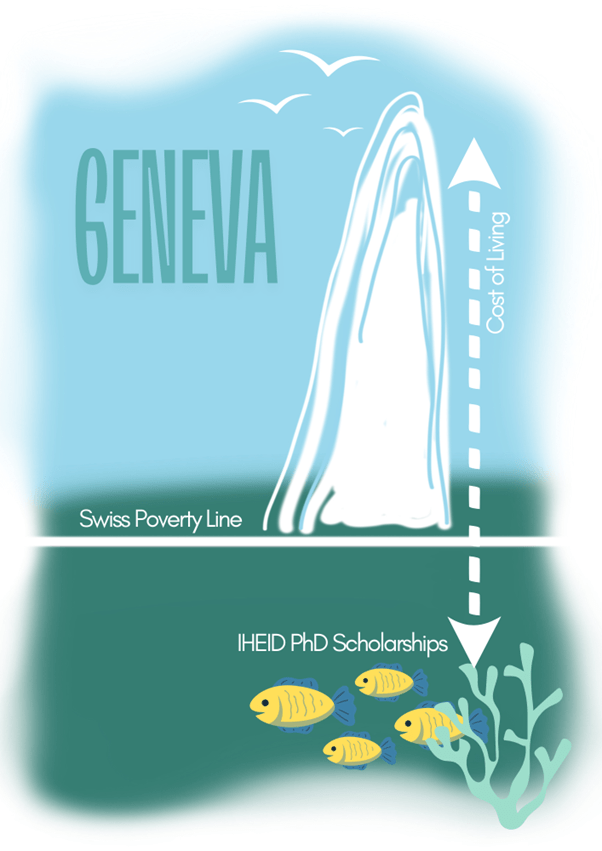
The petition asks for three things: First, that all PhD scholarships at the Institute are brought above the Swiss poverty line; second, that the teaching assistants’ contractual conditions (or equivalent roles) be at par with their Swiss National Science Foundation and UNIGE counterparts, with respect to both remuneration and social security; and third, that the Institute commit to systematically offer support to fifth-year PhD researchers, since a five year duration has been the de facto norm for completing the PhD. PhD researchers ask this, as the current conditions preclude a dignified life in Geneva, and undermine the quality of research.
How does it also concern MINT reforms?
The proposed MINT reforms introduce a ‘selective’ Master thesis option alongside a redesigned professional track. Prima facie, the reform appears to prioritise individuals’ interest in research and responsiveness to labour market needs. However, this approach has structural consequences. First, such a selectiveness would exclude students without any prior background in academic writing, and second, it can be seen as an ideological shift towards professionalisation of the Institute, potentially eroding the Institute’s academic rigor.
In an ideal scenario, the PhD and MINT reforms can be pedagogically aligned. This means, Master’s students should be allowed to explore research pathways without restrictive conditions, while PhD researchers could provide support to Master’s students, thereby creating more work opportunities, especially for the fifth-year PhD researchers. In the current state, both reforms curtail academic freedom and undermine the institution’s scholarly legacy.
Quality Funding for Quality Research
While fair working conditions for the doctoral program are essential to maintaining the Institute’s position as a hub for high-quality research and teaching, adequate funding is equally crucial to upholding mental health and dignity of work. Offering such support to its PhD researchers is not only a matter of the Institute’s moral responsibility, but also a practical necessity, as many struggle to meet basic needs, including housing and decent health insurance. The current practice is also juxtaposed to the Institute’s obligations under the federal law, as Switzerland requires all accredited universities to particularly support the career development of PhD candidates.
Now that the Institute’s 100th anniversary is around the corner, it is time to rethink its vision and goals. In a world where academic freedom is increasingly threatened by funding cuts and political instability, it is an opportune moment for the institute to shape a lasting legacy: to cultivate critical thinkers, independent researchers, and future leaders—precisely the values for which Geneva and the Institute have been historically known for. Currently, that legacy is falling through the cracks. We, the PhD researchers, therefore, urge the institute to create a space for constructive and mutually beneficial negotiations to address the concerns raised in the petition.
 The Graduate Press - La Gazette de la Paix
0 comments on “The Moral Economy of PhDs”