
By Laura Minnetian, Junior Reporter
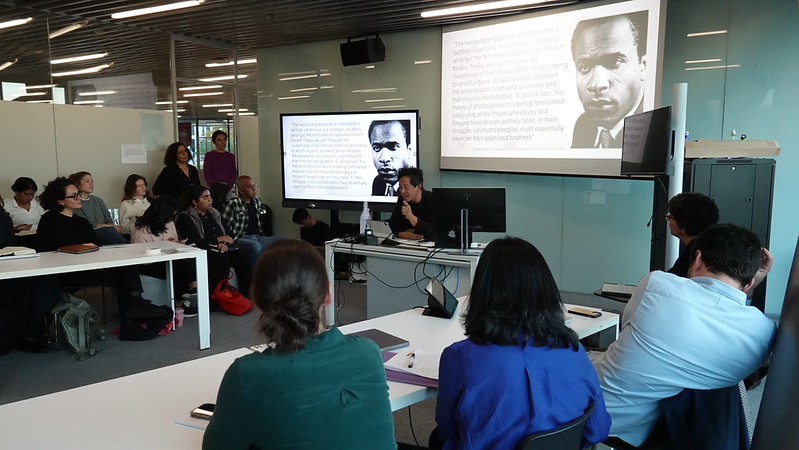
On a sunny Wednesday afternoon, a crowd of intellectuals gathered at the Graduate Institute in Room S5 in Petal 1, to listen to Professor Julian Go’s talk, titled “Anticolonial Thought and Social Theory”, organized by the Anthropology and Sociology department. The talk focused on exploring alternative frameworks to the conventional Eurocentric canon and on ways to incorporate more non-Western perspectives. The room was packed, the air thick, and attendees were sitting on the floor or standing in the doorway – a testament to how eager they were to hear Professor Go’s talk. Julian Go is a Professor of Sociology at the University of Chicago, researching social logics, forms, and impact of empires and colonialism, with a focus on postcolonial and decolonial thought and related questions of social theory.

Pictures by MdReza Eghbali
Professor Go began his presentation with an introduction to Apolinario Mabini, a non-academic activist and anti-colonial thinker from the Philippines. Mabini sought to theorize society as a crucial part of his activism to establish a postcolonial government. He sees this as proof that non-academic figures were also engaging in sociological thinking at the same time as famous white male thinkers, whose social theories were deeply embedded in imperial thought. He used this example to argue that the presentation is more about “Anti-colonial Thought as Social Theory”. He then explains sociology’s rootedness in imperialist and colonial history, and how it continues to ignore this history of empire, a legacy which still shapes academia today.
He points out the key issue with academia’s current standpoint by showing how most sociologists respond to his research on anti-colonial thought: “They often say that this might be interesting, but cannot be useful as a universal theory, because anti-colonial thinkers only look at specific areas.” Go contradicts this perspective by pointing out that contemporary social theory is largely dominated by Western ideas, despite the fact that the majority of societies are either colonized or have a colonial past.
Go presents three central ideas for addressing the current dilemma. Firstly, he argues for the need to rethink the sociological canon. He suggests that anti-colonial thought should be understood as an alternative, heterogeneous form of sociology, one that emerges from diverse experiences and contexts, yet is connected through shared ideas and concerns. Unlike other similar approaches that aim to restore anti-colonial thought, he does not seek to exclude the well-known imperial thinkers. Instead, he aims to broaden the scope to include everyone and to step outside the dominant Western framework. He emphasizes that there should be more engagement with ideas rather than individuals.
Secondly, it is crucial to him not to view anti-colonial thought as an ‘outsider’ or as something uncontaminated by European influence. Instead, he emphasizes that anti-colonial thought has long engaged critically with Western theories, as it emerged in response to Western domination. This engagement, he argues, should be reciprocal: Western thinkers should likewise engage seriously with anti-colonial thought.
In his final point, Go challenges the idea that knowledge is regional. He argues that this way of thinking reinforces colonial logic. This can be exemplified by the selective inclusion of new thinkers from the Global South, whose perspectives are presumed to automatically oppose the West and then frame it under the banner of inclusivity.
During his hour-long presentation, the room was silently engaging with what had been said. As soon as the floor was opened for debate, questions began to pour in. Someone in the audience voiced what many of us were probably thinking: how should academics within Western institutions navigate this, while being part of an institution that remains, in many ways, colonial?
Go responded: “We can ask this question for every position or dilemma in academia. How can someone be a feminist, a Marxist, or an anti-capitalist while being in academia? We have no choice but to live with the contradictions. My goal is very humble, making this existing discipline more open and enriching our social imagination.”
Another question arose: “Is it possible to retain some of the canon (of the imperialist thinkers)?”
“Yes, of course”, Go answered. “They are valuable, but it is just one standpoint, as much as anyone else’s, and we should treat them equally. Also, their provinciality has to be recognized and contextualized, because every theory comes from a place, and we have lived too long with a certain dominant set. We cannot just stick with Marx, we need a multiplicity of perspectives rather than restricting them.”
It becomes clear that Go advocates for a very open and inclusive approach to academia by embracing both existing and emerging ideas: “I’m not trying to rewrite academia. My approach is not that radical because I still believe in social science”.
His final remark reflects his openness and humility: “Reforming our disciplines differently? I cannot quite imagine what that would look like, but I’m very open to it!” This willingness is exactly what academia needs to move forward.
 The Graduate Press - La Gazette de la Paix
0 comments on “Decolonizing Academia – A report on Professor Julian Go’s talk on “Anticolonial Thought and Social Theory””