
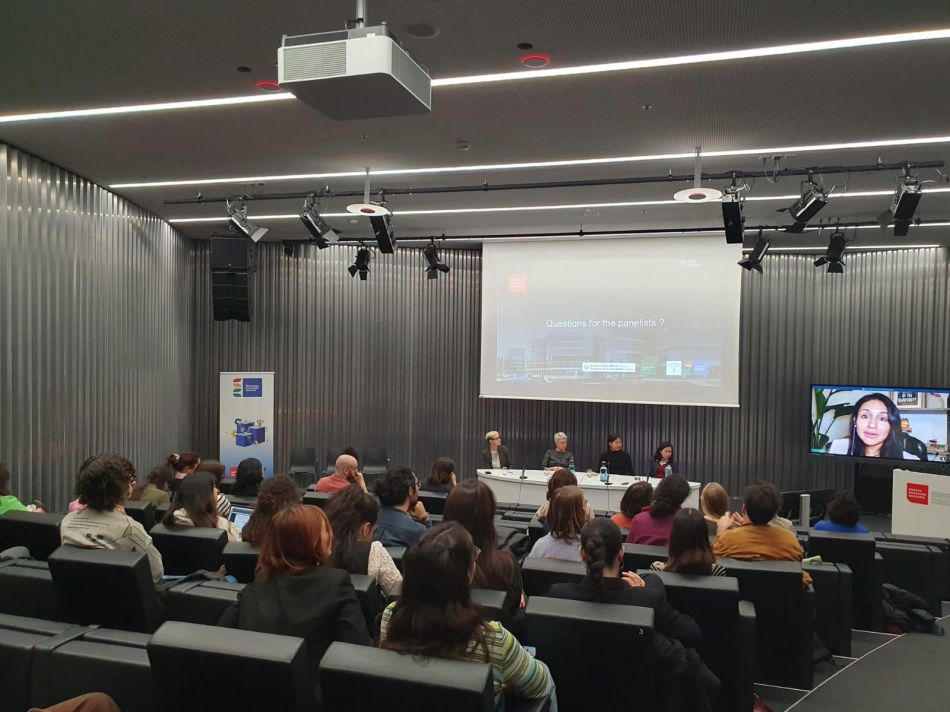
In an era where “sustainability is no longer a choice but a necessity”, the role of women in this field has become increasingly significant. The recent sustainability week panel at the Institute conducted by the environment committee underscored this, emphasising that true sustainability is about action – one that does not come at the cost of the future but rather ensures its preservation. This year’s discussions carried a strong message: sustainability is a nationwide movement that requires tackling critical challenges and women are at the forefront of this endeavour.
The event coincided with the 30th anniversary of the Beijing Declaration, serving as a call to action to continue the work already begun. It was not merely about liberation or environmentalism in isolation but rather about a fundamental shift in how sustainability is approached at all levels. The discussion focused on grassroots movements, sustainable innovation, and the systemic barriers women face in leadership roles, highlighting the spirit of collective action as essential to progress.
Defining Sustainability and the Need for Inclusivity
Elisabeth Prügl, former head of the Gender Centre at the institute and a key speaker, examined the very concept of sustainability, tracing its rise in global discourse since the 1980s. She noted that while sustainability is often defined in terms of environmental, social, and economic dimensions, it is also about the quality of being upheld as valid, correct, or true. However, there are systemic root causes that still need to be addressed – modernity and patriarchal frameworks have historically positioned sustainability as a matter of control, often mirroring the North’s dominance over the South. To be truly sustainable, inclusivity must be at the core of our approach, breaking free from these entrenched systems of control and exploitation.
Despite playing a critical role in sustainability efforts, women remain underrepresented in leadership positions. Less than 30% of women hold leadership roles in sustainability-related fields, making it clear that meaningful progress cannot be achieved without their full inclusion. The panelists emphasized that incorporating women into leadership is precisely in the spirit of collective action.
Dr Stefania Bonilla Ferret pointed out that women are often expected to possess a comprehensive knowledge of every aspect of sustainability, placing undue pressure on them in professional settings. However, their contributions to policy-making and sustainable development remain indispensable. She highlighted examples where women-led investment policies have directly contributed to economic stability and sustainable development.
Where are the Women?
Dr Rosa Vásquez provided a striking example of how climate change disproportionately affects women, particularly in rural and indigenous communities. In the lowland Amazon, many women depend on traditional fibre arts for their livelihoods, using seeds and natural dyes derived from the forest. However, with the Amazon experiencing its most disastrous drought period, these resources have dried up, forcing women to purchase chemical dyes that are expensive and less sustainable. This crisis underscores the urgent need to address the gendered impacts of climate change while ensuring women have access to sustainable alternatives and economic independence.
Equity of Knowledge and Question of Traditional Wisdom
The panel stressed on the importance of bringing indigenous and scientific knowledge to the same level in global discussions on climate change. Ms. Khulan Berger expanded on the role of consumer behavior in sustainability, emphasizing the human challenge of how we consume. Moving from a medical background to a focus on sustainability, she highlighted the necessity of evolving entire ecosystems rather than applying temporary solutions. She referenced the ‘15% rule,’ underscoring that at the end of the day, systemic change requires both individual and collective action.
The Power of the Collective
The discussion also delved into the force and power of the collective, particularly in youth engagement. There is an ongoing underestimation of the influence of young people in shaping sustainability policies, yet they are increasingly becoming key players at negotiation tables. The panellists argued that youth are not just passive participants but are critical to holding institutions accountable. The earlier they take on responsibilities, the more effectively they can drive systemic evolution. Echo anxiety, a growing concern among younger generations, was also addressed. The solution, as suggested by the panel, is action – “no matter how small”. Even grassroots projects contribute to larger change and empower individuals to feel part of the movement.
Overcoming Barriers and the Role of Policy
Policy-making remains a crucial battleground for gender inclusivity in sustainability. Dr Bonilla Ferret pointed out that investment policies often overlook the gender angle, leading to lower funding for women-led projects. Currently, only 3% of investments go into women-led sustainability initiatives, despite their direct impact on communities and economies. The panel discussed how policies need to be structured with gender inclusivity in mind, ensuring that women’s issues are recognized as socio-economic issues rather than being sidelined.
Elisabeth Prügl reinforced that there can be no underestimation of women’s leadership in sustainability movements. Women have been at the forefront of resisting environmental degradation, from protesting against land mining to addressing the gendered division of labour in rural agricultural communities. In one striking example, a rural community suddenly found its fields flooded with saltwater due to environmental mismanagement, devastating their agricultural output. Such crises illustrate the urgent need for inclusive leadership in sustainability efforts.
The panel was successful in highlighting the fact that sustainability cannot be truly achieved without inclusivity. Whether through leadership, grassroots movements, or policy-making, women (women as a broad category!) must be given the space to lead and innovate. The event left attendees with a powerful idea: true sustainability is not just about preserving the environment – it is about challenging the structures that perpetuate inequality and taking collective action to build a future that works for all.
 The Graduate Press - La Gazette de la Paix
0 comments on “A Recap on Sustainability Week: Women Leading the Charge”