
By Sreelakshmi Sajeev, News Editor of The Graduate Press and Nora Sullivan, Advocacy Strategist of MENA
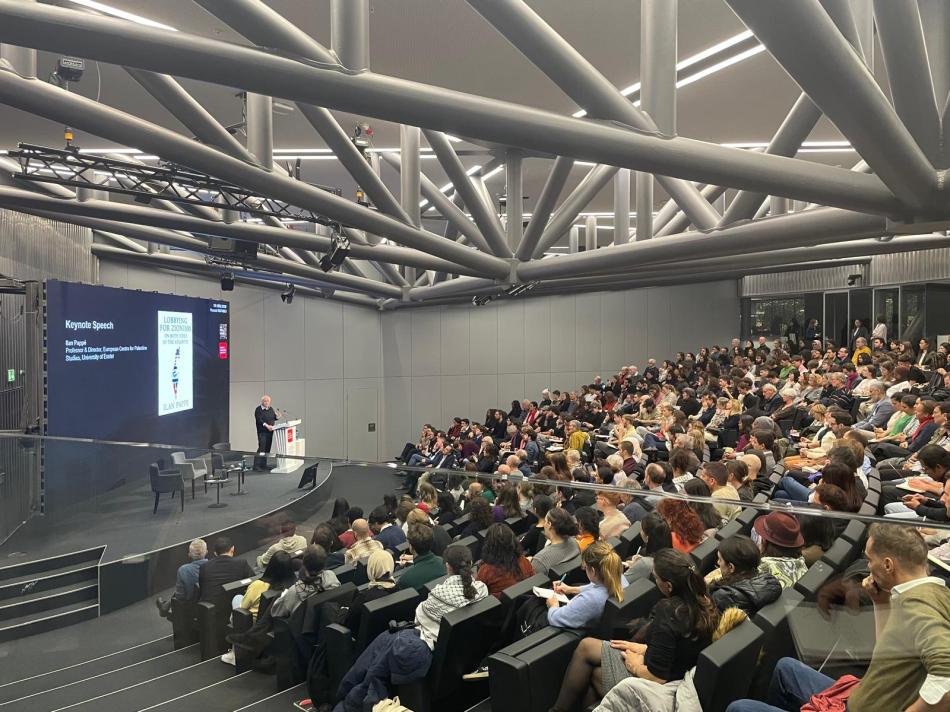
Last Thursday, Maison de la Paix’s auditorium was abuzz with intellectual energy as hundreds of students, academics, activists, and professionals gathered for the Conference on Zionism. Organized by the Middle East and North Africa Initiative (MENA) and supported by the Graduate Institute, the event featured eight distinguished speakers across three panels, diving deeply into the historical, theological, and political dimensions of Zionism. Attendees from within and beyond the Institute came together to engage in rigorous discussions on the evolving paradigms and future implications of Zionism as its project commits an ongoing genocide against the Palestinian people.The conference served as a rare space for critical inquiry, which, as Professor Ilan Pappé remarked in his keynote speech, exemplified the type of academic commitment to truth and justice that is glaringly absent in most Western universities today.
“The power paradigm of zionism and its practices”
The first panel on the Power Paradigm of Zionism featured Hagar Kotef, professor of political theory at SOAS, University of London, Joseph Daher, visiting professor at Lausanne University, and Dr. Raouf Salti, urological surgeon and founder of Children’s Right to Healthcare.
Professor Kotef started her discussion by emphasising Zionism’s dual identity as a liberation movement for Jews and a settler-colonial project, the foundations of expansionism in the ideology of creating a ‘homeland’ through displacing native populations, and its long history of dependence on tropes of vacant land that can be captured through occupation, demolition and eventually ethnic cleansing – a distinction that was later challenged by other panellists. She voiced the fact that although 7 October 2023 was the worst event for Jewish people since the Holocaust, the last 14 months have been the worst event for Palestinians, probably even worse than the Nakba in 1948. Discussing the operations of the Zionist project, she highlighted that in their effort to establish themselves as indigenous to the land, settlers have systematically displaced existing populations through expulsion or, as witnessed today, acts of genocide. Professor Daher’s opening remarks followed Kotef’s and were just as strong. He appreciated the event organisers for defending academic freedom and went on to elaborate on the imperialist colonial objectives of the ideology and extended on how the rise of right-wing populist regimes across the world contributes to or impacts what’s happening in Israel and Gaza. He explained the sort of symbiotic relationship between Israel and the West and how it is sustained through mutual economic and security benefits. According to him, Western imperialism is deeply tied to the oil and gas economy, with Israel’s presence in the region offering a degree of strategic control over it.
Dr. Raouf Salti shared his insights on the medical challenges Palestinians face both in Gaza and outside. He is the founder of Children’s Right to Healthcare, an NGO that works to bring children who have been injured in Gaza for essential operations in Switzerland. Tragically, the long wait for the Swiss medical visas and the battles with Swiss bureaucracy took too long and most of the children he had hoped to bring did not survive the wait. He continued his efforts, stood firm, and eventually managed to bring eight children to Geneva for treatment. He also narrated evocative stories about Israel’s medical apartheid system that treats Palestinians as second-class citizens. The panel concluded by Dr. Salti underscoring the fundamental choice of humanity over everything, the need to find courage to persevere and not allow humanity to perish at this moment.
“Zionism is not one thing but it’s many things“
The first session drew people in, and the second session gave them necessary context and a historical grounding to fully understand the complexity of the topic. The panel was preceded by a documentary screening of “And There Was Israel” (2018), directed by Romed Wyder. The documentary traces the use of force, propaganda, ideology, and financial backing behind the establishment of the Jewish state of Israel.
The discussants for the next panel on The History of Zionism (late 1800s – 1948) were Cyrus Schayegh, Chair of the Department of International History and Political Science and Riccardo Bocco, Professor Emeritus of Anthropology and Sociology. The panel looked into the intricate entanglement of Zionist history with Western imperialism, framing it as both an ethno-nationalist project and a colonial ideology. Professor Bocco emphasized that Zionism was rooted in Jewish nationalism and reliant on imperial powers of the West for its establishment and survival. He highlighted the role of Western powers in creating Israel as a solution to the ‘Jewish problem’, using Palestine as a colonial site for settlement while failing to define the exact contours of a ‘Jewish state’. The United States emerged as Israel’s steadfast patron by the end of the 1960s, not only through military and financial support but also as a partner in shaping geopolitical narratives. Professor Schayegh noted that historically colonial projects have always needed to work with locals in order to be successful, which is why the simultaneous ‘Europeanness’ of the new Israelis and their critical ‘Otherness’ from their European backers created the perfect combination for Zionism to achieve success in creating Israel. The discussion concluded with important questions of identity dilemmas, including the erasure of Arab-Jewish identities and highlighting how Israel continues to ‘give back to the West’.
“Towards alternative solutions and the future of the Zionist Paradigm”
The first two panels had nearly full attendance, but ushers were turning people away at the door for Ilan Pappé’s keynote. Among thunderous applause, Ilan Pappé took the stage. He started his speech by re-emphasizing the origins of Zionism in European colonialism, describing it as a “solution to a Jewish problem” imposed on Palestine by external powers. Pappé did not hesitate to speak truths, including that the events of the 7th of October happened in a context, even though, as he noted, the use of the word ‘context’ has become associated with terrorism and antisemitism. In his words, “Israel is a failed state” and “we can see the beginning of the collapse of the Zionist project”. This is reflected through the growing cracks in Israeli society, growing distrust in the state institutions, and the rise of fascism. “The Zionist project is failing Israelis and killing Palestinians” Pappé commented. This is, according to him, not a surprise, since Zionism has always been a modus operandi that can only be implemented by force. His speech called back to what other panellists had mentioned, including the Evangelical Christian support of the Zionist project due to their belief that the ‘restoration’ of the Jewish people to Palestine would lead to the second coming of Christ, and the fact that “without British support, the Zionist project would have failed” anyway. Pappé used strong language to label the occupied Palestinian territories as “the two biggest prisons on earth.”
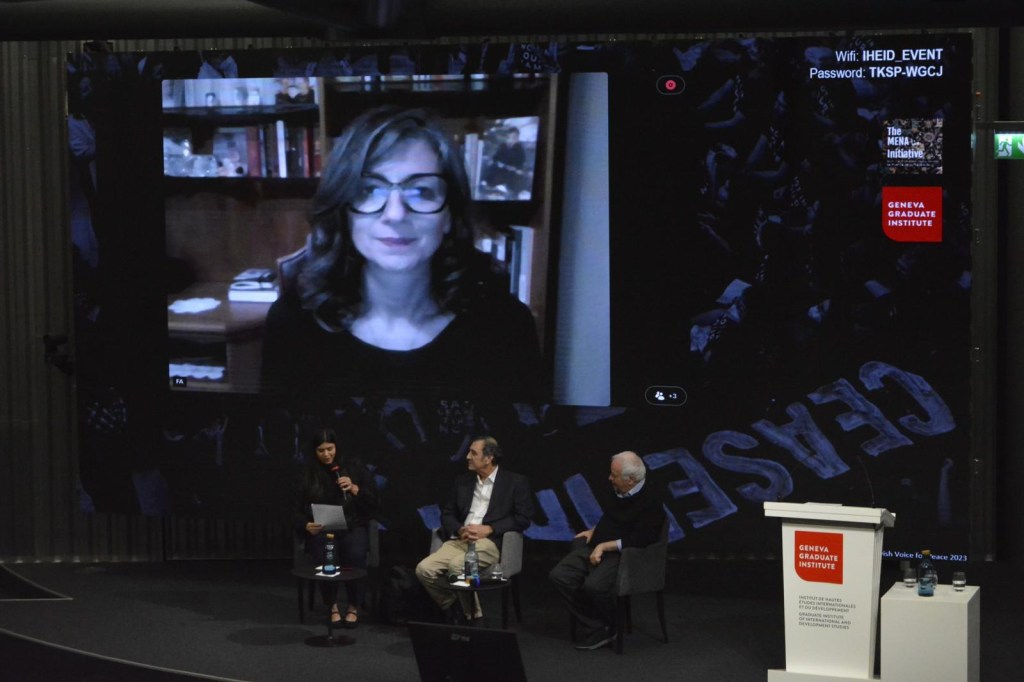
The panel on the future of Zionism and the role of International Law. Image copyrights reserved for MENA©
In the final session, Ilan Pappé was joined by Nur Masalha, Palestinian historian and Francesca Albanese, UN Special Rapporteur for the Occupied Palestinian Territories (virtually). The panel took a pragmatic perspective in understanding the real-world implications of Zionism and a potential post-Zionist future. The panel discussion highlighted the urgent need for decolonization and a reimagined framework of justice. Professor Masalha reflected on the genocidal policies of the Israeli state and its transformation into a fascist regime, cautioning against its implications for both Palestinians and global stability. He emphasized the expulsion of the Palestinians from their native land, a concept Professor Pappé famously called ethnic cleansing. Much like Dr. Salti earlier, the perspective he brought was not just academic but personal. He stated that the last 14 months have been traumatic for all Palestinians, himself included. Referencing Pappé’s idea of a one-state solution, he states, “It is very difficult for Palestinians to go through Genocide and think about living jointly with their genocider”. However, he urged us to imagine Palestine 7000 years into the future. In response to a question related to his research on Zionism making itself native in the land of Israel, Masalha pointed out that when he says Palestinians are indigenous to the land, he does not just mean Arabs, Muslims and Christians. Palestine, Professor explained, has a history going back more than 4000 years and has always been a multilayered, multicultural, and tolerant society; Gaza has been one of the greatest cities of the ancient world, a city of trade and academia.
Francesca Albanese started off her opening remarks by powerfully stating that Israel is committing not only genocide, but also ecocide, domicide, and scholasticide. She emphasized the systemic nature of colonial erasure perpetrated by the Israeli government. Replying to a question on the role of international law in determining the conditions for genocide to have been met, she advocated for restorative justice and holding perpetrators accountable, framing Palestinian liberation as integral to global struggles against structural injustice. She expanded on how the system sustains its ‘colonial practises’ and reproduces systemic injustices and that Palestine is, for her, “a metaphor to understand the injustices of the system”. Albanese’s remarks emphasised the need to reform the international law order to pressurise states to take accountability for the genocide happening in Gaza for the past 14 months.
On Thursday night, Ivan Pictet A1 transformed into a powerful space of solidarity as the panel concluded with a call to abandon ‘the two-state solution’ and urging a global shift towards accountability and restorative justice for the Palestinians. Because Prof Masalha invoked poet Mahmoud Darwish in his discussion, we are concluding with his words: “No night is long enough for us to dream twice”, a poignant reminder that while the future remains uncertain, yet for the unbreakable people of Palestine, this ability to dream must endure, and the world should do better.
 The Graduate Press - La Gazette de la Paix
0 comments on “Confronting And Unpacking The Truth: Conference on Zionism”