
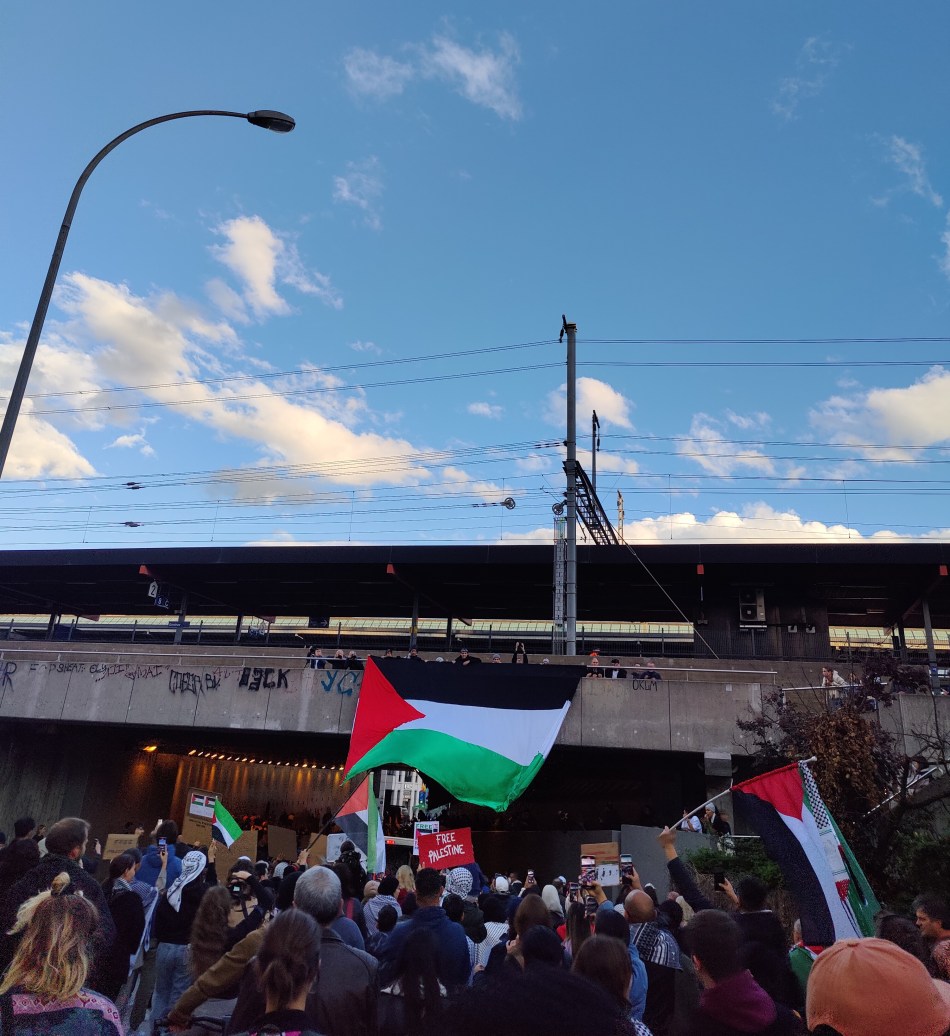
By Decolonial Action Network
The curiously titled “Standing together for peace in the Middle East” statement graced our inboxes on October 23rd – a full two weeks into the outbreak of war on Gaza. In their own uniquely swift fashion, the leadership of an institution dedicated to the rigorous study of salient global affairs finally decided to weigh in.
In principle, this should have been a welcomed development, particularly given the deafening silence and, at times, open support of Israel and active censoring of advocates for justice in Palestine pervading academic institutions in Switzerland, Europe, and North America. However, the statement’s lack of clarity, reproduction of flawed narratives, and substantive failure to recognise the ongoing ethnic cleansing of Palestinians in Gaza, alongside the broader Israeli colonial occupation and apartheid, stand in stark contrast to the principles of excellence, critical thinking, and engagement championed by the Institute’s Charter that are supposed to guide our community in the fight for a peaceful, equitable, and sustainable world.
Indeed, if the cliched title did not tip you off, then the ensuing three paragraphs unequivocally shattered any expectation of a principled stance. Enveloped in nebulous language, it was a quintessential example of a nothingburger, complete with calls for “upholding international law by all warring parties.” The Israeli military armed to the teeth with the unconditional support of Western governments on the one hand and the 2.2 million besieged and largely defenseless Gazans, on the other.
The so-called Israel-Hamas war—an erroneous phrasing the Institute has regrettably adopted—is an obfuscation of Israel’s relentless and indiscriminate bombardment campaign in Gaza. What we are witnessing is not merely ‘a tragic human and humanitarian situation,’ as professed by our Direction, but more precisely, the industrial annihilation of a captive population—an act tantamount to genocide.
While the Direction has taken a firm stance against the ‘deliberate killing and hostage-taking of civilians,’ it is the subsequent vague portrayal of the war’s ramifications on Gaza as ‘dramatic’ that raises eyebrows. The use of passive language inadvertently plays into the dehumanizing narrative that has been wielded to justify the mass and calculated killing and displacement of Palestinians, as if they were mere collateral damage within Israel’s collective punishment strategy.
As a reminder, Israel’s US and EU-backed campaign has claimed the lives of 7,028 Palestinians, including 2,913 children, and has led to the devastation of vital infrastructure, including hospitals, schools, places of worship, bakeries, and homes. These are elucidatory numbers and facts that are missing from a statement insistent on obscuring the scale of destruction in Gaza.
It is thus imperative for our Institution to make explicit the catastrophic nature of Israel’s offensive on Gaza and honor its commitment to a peaceful, equitable, and sustainable world. The statement constitutes a missed opportunity, especially at this critical juncture, when instead of calling for an immediate ceasefire, the Swiss Department of Foreign Affairs has announced the suspension of funding to 11 Israeli and Palestinian human rights NGOs.
What the Direction vaguely alludes to as ‘peace in the Middle East’ masks a disturbing reality: a regression to a status quo that has been astutely classified as an apartheid regime – a core driver of the violence. This crucial historical context is conspicuously absent from the Direction’s statement—astonishingly so since it boasts our faculty’s and researchers’ expertise ‘on the current and wider dimensions’ of the crisis. This omission perpetuates the misguided framing of the October 7th events as ‘unprovoked.’ Recognizing this vital history would lead us to understand that a genuine project toward peace in the region can only begin by acknowledging and addressing the political rights of Palestinians, their right of return, and the cessation of the Israeli settler colonial enterprise.
The problematic nature of the equivalence drawn between the ‘two warring parties’ is endless, not the least because it neglects to acknowledge that Israel is an occupying power and, as such, bears obligations towards the people under its occupation – obligations that have been flagrantly disregarded for a number of decades now.
Perhaps of particular concern to each of us as members of a higher education institution is the deliberate targeting of universities, exemplified by the recent assault on the Islamic University of Gaza. Even prior to October 7th, Israeli occupying forces have routinely conducted raids on Palestinian university campuses, detained students and faculty, including our colleagues at the Geneva Graduate Institute, and inflicted damage on university facilities, both in the West Bank and Gaza. Conversely, Israeli universities are intricately entwined with Israel’s occupation project, lending support both intellectually and materially.
On October 18, 2023, strong of hundreds of votes in favor, the Institute’s student body endorsed a statement both decrying the indiscriminate bombing campaign in Gaza and standing in solidarity with Palestine. Students formally appealed to the Direction, which received the statement the following day, to take a strong stance beside the Palestinian people, to provide support to our colleagues as needed, and to make visible and interrupt all collaboration with companies and institutions complicit with Israeli apartheid and colonization.
In times like these, moral clarity is the bare minimum. We therefore implore the Direction to engage with and address students’ demands. This should begin by showing more lucid comprehension of the situation and using appropriate and precise language in any forthcoming statements regarding the war. We also call for a considered and principled stance in recognizing the genocide currently unfolding in Gaza. Then, in alignment with fundamental respect for human life, we urge the Direction, Administration, and Faculty to clarify and rectify the Institute’s complicity with Israeli apartheid and colonization including a reevaluation of all partnership ties with companies and institutions directly or indirectly involved in the occupation and dispossession of Palestine.We invite you to check this page for updates on coming mobilizations in Switzerland in solidarity with the Palestinian people and join the national demonstration in Bern on 4th November. In the meantime, you can consult this document, compiled by activist groups at our Institute, for educational resources about Palestine and our commitment to establishing an apartheid-free zone at IHEID.
Photo Credits: Dhouha Djerbi
 The Graduate Press - La Gazette de la Paix
0 comments on “Ensemble Contre le Génocide – Standing Together against Genocide: Response to the Direction’s Message on the War on Gaza”