
By An Anonymous Collective of Current and Former IHEID Students
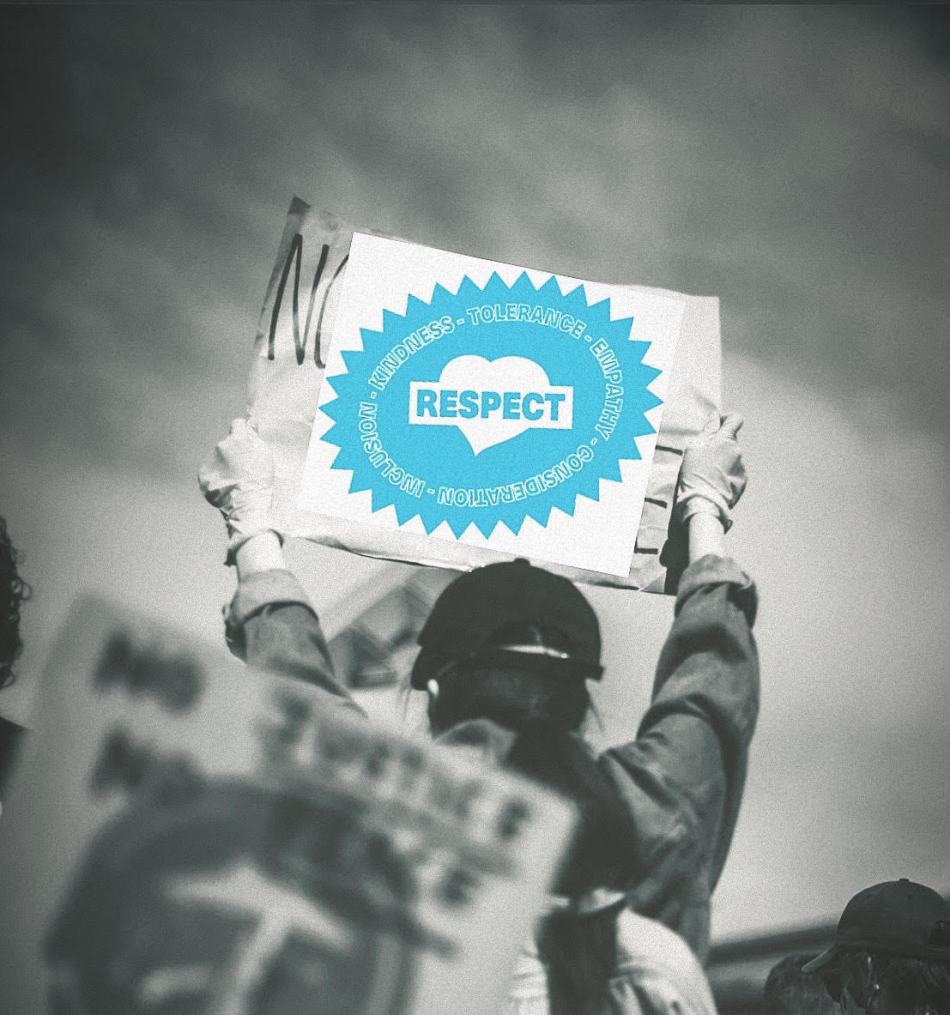
The “Respect” campaign at the IHEID is hard to overlook. Through ubiquitous blue, red, and green stickers, posters, promotional videos, and social media presence, the administration rhetorically asks “Respect: what does it mean to you? Respect each other and our differences, respect our diversities.”
Yet for many, this campaign stirs up a sense of unease. Whilst it appears well-intentioned on the surface, it is important to recognise that such university-led diversity initiatives do not occur in a vacuum. In many cases, these efforts can be seen as a form of “respectable” response from administrations to quell student activism, a trend supported by a growing body of literature.1 Often, these campaigns lack genuine co-creation or dialogue with students, perpetuating inherent power imbalances. Maybe that is why the campaign speaks at students, and at students only. Promoting ideas such as “respect” whilst the Institute’s actions display otherwise rings hollow and disingenuous at best, and downright insidious at worst. The Respect Campaign at the IHEID exemplifies what is known as a respectability narrative, a form of dialogue and narrative construction often employed to silence marginalized groups, especially those brave enough to speak out against injustices and inequalities. Respectability narratives are often employed by administrations, which together with the blatant lack of student influence, create an atmosphere where marginalized groups feel pressure to conform to certain respectability politics in order to exercise their rights and have their concerns acknowledged, heard, and ultimately addressed.
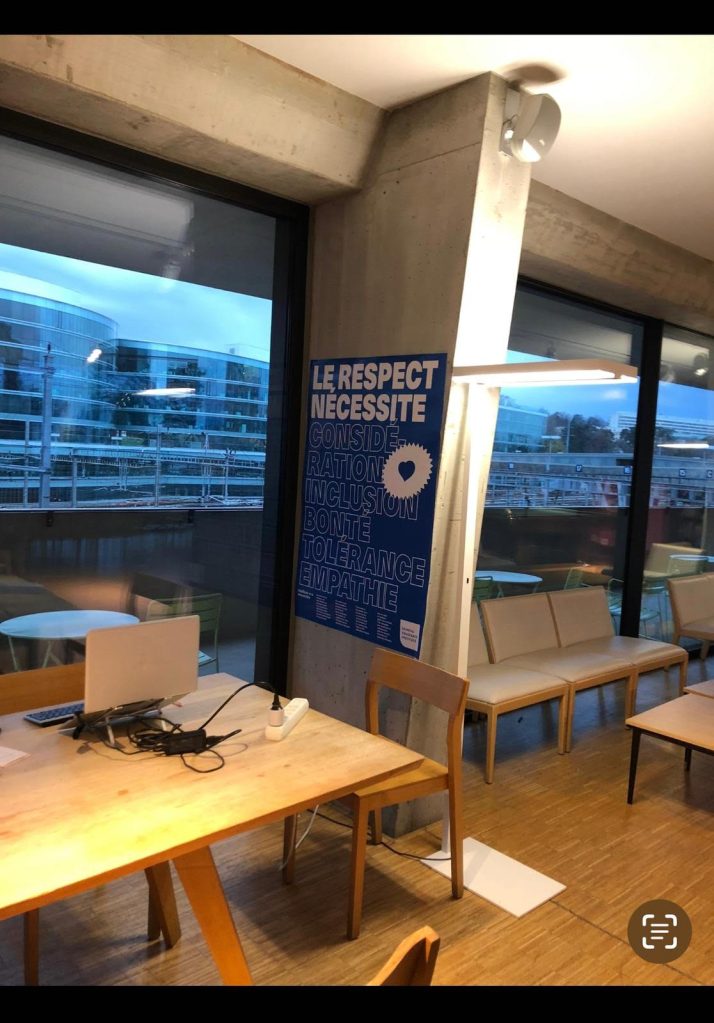
The vibrancy and character of one of IHEID’s few student spaces were replaced by “Respect” posters.
A telling example of this campaign’s impact on respectability politics was the removal of all political posters from the Picciotto Common Room. These posters, representing diverse student perspectives and political engagement were replaced by the “IHEID Respect” campaign branding. This removal occurred during the December 2022 winter break when many students were away, effectively erasing an essential physical space for student expression and activism.
It is well known that PCR is one of the only student spaces at the Institute and one characteristic of that space was the presence of numerous political campaigns and informational posters that represented the activities and passions of our students. It was a veritable museum of our students’ aspirations for a just future.
Other student and workers’ initiatives have been similarly silenced. Last April, the ADA launched a poster campaign to denounce poor contractual conditions. Their already precarious status was exacerbated by continuous unilateral changes to their contracts by the administration. Their plights were removed from walls and doors as soon as they were put up, and information packages in common areas thrown to the garbage.
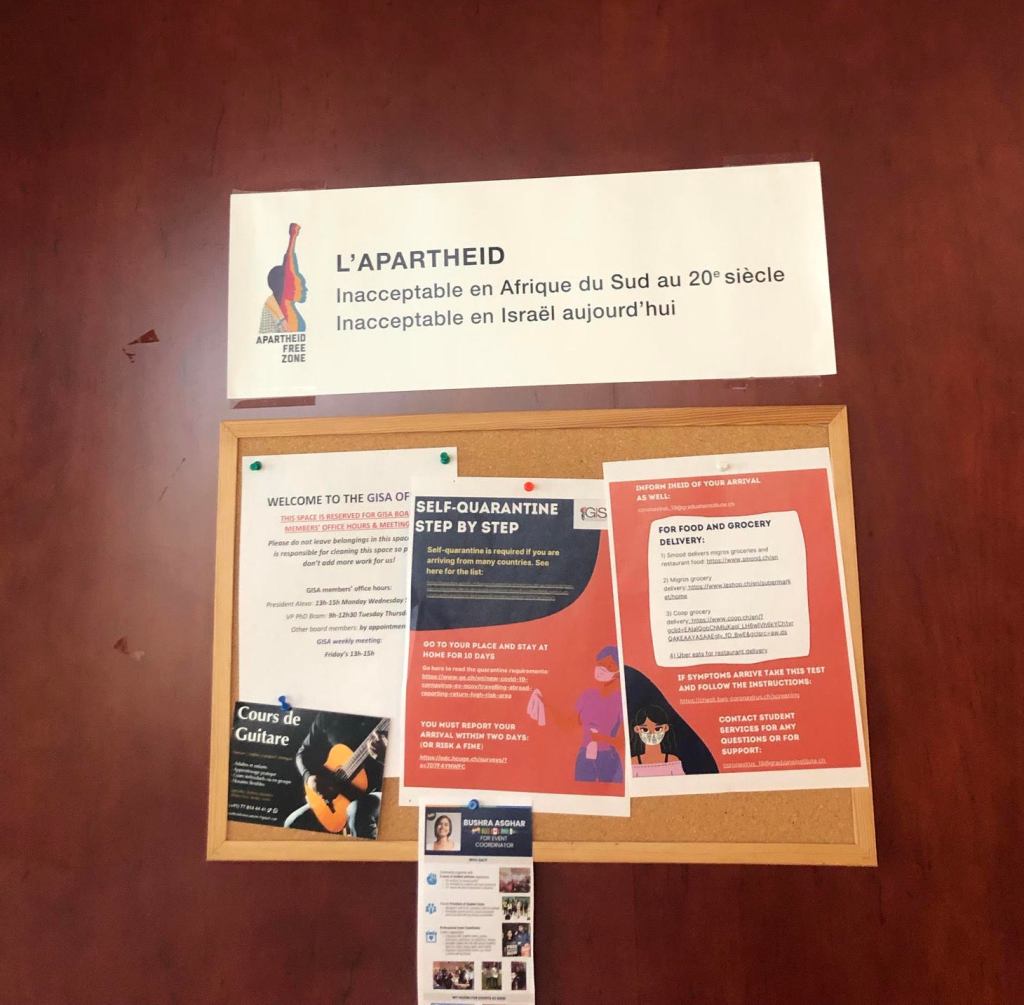
No episode underscores the administration’s discomfort with student political engagement like its response to the Boycott, Divestment, Sanctions campaign in 2021. The apartheid-free zone poster was a testament and reminder of the values that the student body endorses. Its removal has left a lingering sense of frustration and fear among students.
Respect seems to be unidirectional, a privilege reserved for the administration
But who is this “Respect campaign” for? What does the administration deem worthy of Respect, considerations, inclusion, kindness, tolerance, and empathy? Who should do the Respecting? Who should be “fostering the environment of tolerance, inclusion, and understanding among the members of the community” the campaign calls for? Who needs to “contribute to maintaining a safe and healthy learning, working, and studying environment”? There is one undisputed principle guiding this campaign. Our daily actions can make a difference and the combined effect of our actions can be enormous.
So, why doesn’t the ‘Respect’ campaign extend to the lived experience of students at the Graduate Institute? Our Palestinian colleagues must return periodically to a homeland divided by an apartheid regime and watch their families struggle under this regime at a distance. What about respect for the students brave enough to speak up to authority on issues that challenge our very institution? There have been multiple cases in which our director accidentally “replied all” while speaking disparagingly about student activists at the Institute. In another incident, a student and TA representatives were allowed to join faculty meetings to raise their concerns and were shouted at, their demands ridiculed. Could it mean respect for the experience of women in a predominantly patriarchal institution? Such as a new sexual harassment mechanism ignored all student feedback to be victim-centric seemed to be explicitly designed to discourage reporting said harassment. Maybe it is respect for our peers with mobility restrictions, despite the requests to make our place of study more accessible, which have been routinely discarded. Or respect for students who continue to ask for academic and learning support? Many students ask for simple studying aids such as recordings of their lectures and practical sessions only to be told that it is an institutional policy to let the costly and recently-acquired video technology sit idle. Perhaps it is about respect for our employees, such as teaching assistants seeking improved working conditions at the Institute or research assistants trying to secure a desk where to carry out their research from? Being told that because most of us are foreigners, we don’t deserve these considerations, let alone to earn the minimum wage, feels far from respectful. Perhaps the reason some of us “don’t stay” isn’t because of a lack of desire to stay, but more because of the bitter taste IHEID leaves in our mouths, hinting of xenophobia.2
When respect is taken for silence
In this larger context, and through the “Respect campaign” the Institute’s administration seems to be saying: Have free speech, but not publicly and only if it aligns with our views. Speak up against racism, but only in structured settings or admin-led working groups. Don’t organize in student led advocacy groups otherwise you will be labeled and made to feel like “a few isolated radicals”. Advocate for strangers in a distant land, but speaking up on campus may lead to ostracisation and delegitimization behind closed doors devoid of student presence. Be political, but not in our common spaces. Fight against oppression, but don’t declare your union an apartheid free zone or denounce microaggressions taking place in classrooms, meeting boards, and hallways. And definitely think twice before raising complaints of sexual misconduct, especially if it involves people in positions of authority.3 Study politics, power, peace, history but don’t you dare question the Institute.
For those who have been at the Institute for more than a few years, we remember times when advocacy on campus involved a deep sense of student democracy, collaboration, and respectful involvement with upper administration. We remember the few and far apart allies in the administration who did everything in their ability to empower these movements. But we also remember the cold stone wall we ran up against, time and time again, and the brutal defaming and delegitimizing backlash that inevitably followed such humanistic efforts.
This campaign strikes a painful cord for many students, workers, and alumni. Widespread burnout amongst politically active students and teaching and research assistants at IHEID due in large part to the exhausting and stressful experience of advocacy on campus is coupled with a complete lack of student involvement in a wide array of decision making processes. Student engagement in matters pertaining academic and campus life is largely symbolic and tokenized.
We remember when GISA and initiatives held up half the sky during the pandemic, when students bravely navigated political discussions amidst strong disagreements, when students endorsed movements and organized protests, and when GISA provided free sanitary products. We don’t look back and remember the administration being respectful, because they rarely were, despite our shared desire to find workable solutions for our community… That is the goal right?
Perhaps the campaign itself isn’t inherently contradictory to our diverse and politically engaged student body. Instead, it might reflect a disconnect with the institution’s administration.
- See: Linder, Chris, Stephen John Quaye, Terah J. Stewart, Wilson K. Okello, and Ricky Ericka Roberts. ““The Whole Weight of the World on My Shoulders”: Power, Identity, and Student Activism.” Journal of College Student Development 60, no. 5 (2019): 527-542. https://doi.org/10.1353/csd.2019.0048. Ropers-Huilman, Becky, Laura Carwile, and Kathy Barnett. “Student Activists’ Characterizations of Administrators in Higher Education: Perceptions of Power in “the System”.” The Review of Higher Education 28, no. 3 (2005): 295-312.Melody T. Fisher, Still fighting the good fight: An analysis of student activism and institutional response, Public Relations Review, Volume 44, Issue 1, 2018, Pages 22-27. Kezar, Adrianna. “Faculty and Staff Partnering With Student Activists: Unexplored Terrains of Interaction and Development.” Journal of College Student Development 51, no. 5 (2010): 451-480. https://doi.org/10.1353/csd.2010.0001.Linder, Chris, Stephen John Quaye, Alex C. Lange, Ricky Ericka Roberts, Marvette C. Lacy, and Wilson Kwamogi Okello. “”A Student Should Have the Privilege of Just Being a Student”: Student Activism as Labor.” The Review of Higher Education 42, no. 5 (2019): 37-62. https://doi.org/10.1353/rhe.2019.0044.Wheatle, Katherine I. E., and Felecia Commodore. “Reaching Back to Move Forward: The Historic and Contemporary Role of Student Activism in the Development and Implementation of Higher Education Policy.” The Review of Higher Education 42, no. 5 (2019): 5-35. https://doi.org/10.1353/rhe.2019.0043.Student activism: Impacting personal, institutional, and community change.
Tony Chambers, Christine E. Phelps
First published: Summer 1994. Cole, R. M., & Heinecke, W. F. (2020). Higher education after neoliberalism: Student activism as a guiding light. Policy Futures in Education, 18(1), 90–116. https://olh.openlibhums.org/article/id/4429/ Linder, C. (2019). Power-conscious and intersectional approaches to supporting student activists: Considerations for learning and development. Journal of Diversity in Higher Education, 12(1), 17–26. https://doi.org/10.1037/dhe0000082 Mahler-Rogers, Dionicia (2017) “Higher Education Administrators’ Response to Student Activism and Protests,” Higher Education Politics & Economics: Vol. 3 : Iss. 2 , Article 1. Available at: https://digitalcommons.odu.edu/aphe/vol3/iss2/1 https://www.proquest.com/openview/04ac792eb1bb0926657b1ca1b9a9da63/1?pq-origsite=gscholar&cbl=44156 Hoffman, G. D., & Mitchell, T. D. (2016). Making diversity “everyone’s business”: A discourse analysis of institutional responses to student activism for equity and inclusion. Journal of Diversity in Higher Education, 9(3), 277–289. https://doi.org/10.1037/dhe0000037
Cho, Katherine Soojin. University of California, Los Angeles ProQuest Dissertations Publishing, 2020. 28088551.
↩︎ - An absurd debate anyway because of the fact, according to our admission department statistics, most graduates do remain in Geneva, often for many years following graduation. ↩︎
- https://thegraduatepress.org/2022/10/10/its-easier-when-we-have-30-cases-handling-harassment-on-campus/ ↩︎
 The Graduate Press - La Gazette de la Paix
0 comments on “Respectability Politics and the Silencing of Political Student Voices: A Critical Reflection on the Contradictions of the Administration Led Campaign”