
By Hoi Kipgen, Alumni
On June 4th, a seven-year-old boy, along with his mother and a neighbor, were burned alive inside an ambulance while on their way to a hospital. Rumors had circulated that the ambulance was transporting “Kuki militants,” leading the Meira Paibis (“women torch bearers”) to collaborate with Meitei mobs and set the ambulance on fire. No action has been taken to hold the perpetrators accountable for their heinous crimes.
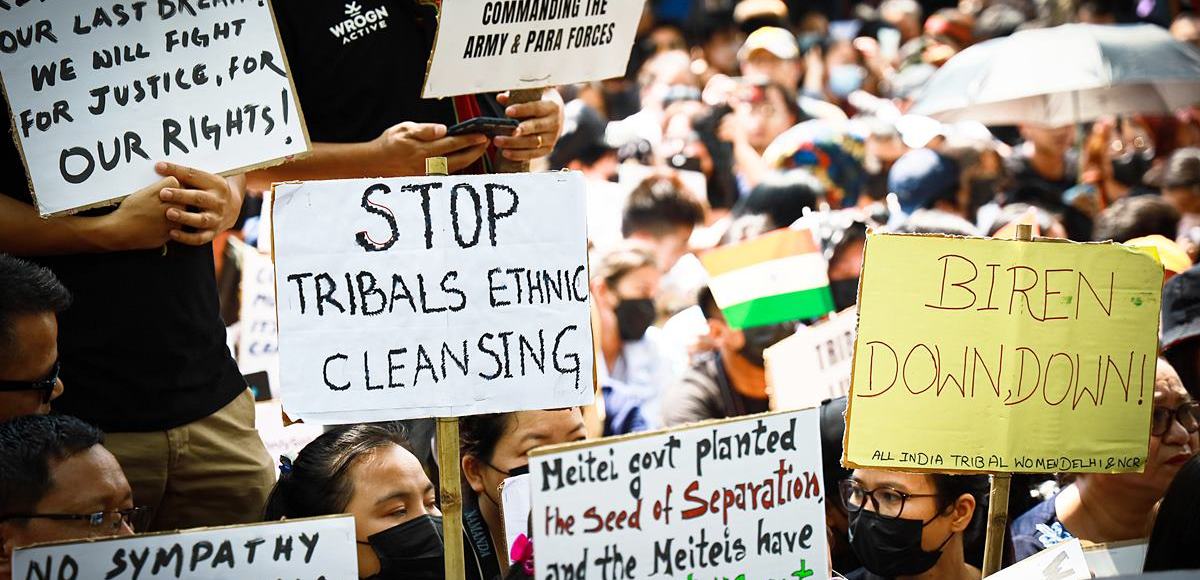
Since May 3rd, more than 115 people have lost their lives, and 40,000 individuals have been displaced from their homes in Manipur, a state in Northeast India. The Indian government has resorted to the common strategy of shutting down internet services. Manipur, which spans an area of 22,000 square kilometers, approximately half the size of Switzerland, is divided into two regions. The valley is predominantly inhabited by Meitei groups practicing Hinduism and Sanamahism, while the hills are home to the Nagas and Kuki tribes who practice Christianity. The violence currently unfolding is between the majority Meitei population and the minority Kuki ethnic group.
Some mainstream Indian media outlets have attempted to explain the violence in the “remote Northeast” as a religious conflict between Hindus and Christians. However oversimplifies a complex issue. Furthermore, this view point is an attempt by the perpetrators to gain sympathy from the Hindu-centric Bharatiya Janata Party (BJP) government.
Root cause of violence
The root cause of this violence can be traced back to earlier this year when Manipur’s Chief Minister, Biren Singh, called for the eviction of tribal villagers from forest areas. He accused the Kuki community of illegal poppy cultivation and labeled them as “illegal immigrants.” The government arrested village chiefs and demolished three churches for alleged “illegal constructions” on government land. On February 20th, Kuki civil society groups, led by the Indigenous Tribal Leaders’ Forum (ITLF), organised peace rallies in several hill districts to protest against the forced evictions of 16 Kuki families from K. Songjang village in Churachandpur district. According to the Kuki villagers, these state-led evictions violated The Indian Forest Act, 1927, and the Forest Rights Act, 2006, which recognize the symbiotic relationship between Scheduled Tribes (including Kukis) and forests. Instead of addressing the grievances raised by Kuki civil society groups, Biren Singh’s government escalated the ethno-political divide, labelling the Kukis as “foreigner Kuki” and “terrorists.”
Tensions reached a boiling point on May 3rd when student-led “tribal solidarity” peace protests against the Meitei community’s demand for scheduled tribe (ST) status turned violent. Simultaneously, a disinformation campaign targeting the Kukis spread rapidly throughout the valley. False news circulated claiming that Meitei women were being raped by Kukis in Churachandpur district. In response, a group of Meitei women handed over two young Kuki women in their twenties as an act of retaliation. To this day, the bodies of these victims lie in the morgue of the Jawaharlal Institute of Medical Sciences in Imphal, while their families plead with state authorities to allow them a proper burial. Numerous incidents like this one have been documented, raising questions about the extent to which this deliberate and planned disinformation campaign served as a pretext for the perpetrators and mobs to commit such atrocities.
Adding fuel to the fire, media outlets and journalists based in Imphal, the capital city of Manipur, have been accused of distorting facts and publishing unchecked stories. Local TV channels then amplify this unreliable news, further exacerbating the ethnic divide. In extreme cases, journalists have faced threats when reporting against the state government or the Meitei Arambai Tenggol groups.
Indian government’s response
Amidst this conflict, Union Home Minister Amit Shah visited Manipur on May 30th, urging both communities to maintain peace and normalcy for 15 days. However, attacks continued to occur in Kuki villages such as Sugnu, Kangvai, Churachandpur, Moreh, and Kangpokpi.
Despite calls for President’s Rule and demands for Separate Administration by the Kuki community in Manipur, the Indian government’s response has been to establish a Peace Committee in which Chief Minister Biren Singh, alleged to be “anti-Kuki” and the mastermind behind this ethnic cleansing, is a member.
Lack of trust and deep ethnic divide
Given the lack of trust in both the state and central governments and the absence of other protective mechanisms, many Kuki civilians have taken up arms to defend their villages.
The Indian government’s disregard and indifference toward the lives of its ethnic minorities is alarming. In the face of deep-seated animosity between the two ethnic groups, establishing a peace committee alone will not suffice. Lasting peace will only be achieved through justice and accountability for these crimes.
Disclaimer: The views and opinions expressed in this article is that of the author. To learn more about the humanitarian crisis in Manipur, you can reach out to her – nemhoilhingkipgen@gmail.com
Whilst you are here!
The Graduate Press is currently raising funds for our 5th-anniversary print edition and we need your help. The last 5 years at the institute have seen some incredible highs and lows and TGP has been there for them all. Now TGP wants to immortalise that history.
If you can, we are currently accepting donations via our GoFundMe page.And if you would like to be involved with The Graduate Press and the 5th anniversary edition you can email us at gisa.thegraduate@graduateinstitute.ch or via Instagram.
 The Graduate Press - La Gazette de la Paix
0 comments on “Inside Manipur’s Ethnic Violence”