
By Valentine Matta
A few days ago, I was at the renowned Geneva University of Art and Design (HEAD). A place that feels almost like a world of its own.
I was there for a joint workshop organized with the Institute: How to Use Textiles as a Political Tool. A curious meeting point between two institutions that rarely overlap. One rooted in artistic creation, the other in policy, theory, and global systems.
The time spent crafting a banner felt like a nice shift from our usual modes of working behind a computer. Meaning was no longer something to refine through language alone, but something to construct through color, texture, and composition. And yet, what stayed with me after the workshop was something else entirely: the encounter between two groups of students, us and them. Not in opposition, but in contrast. Two ways of being young in the same city. Two ways of understanding engagement, expression, and even identity.
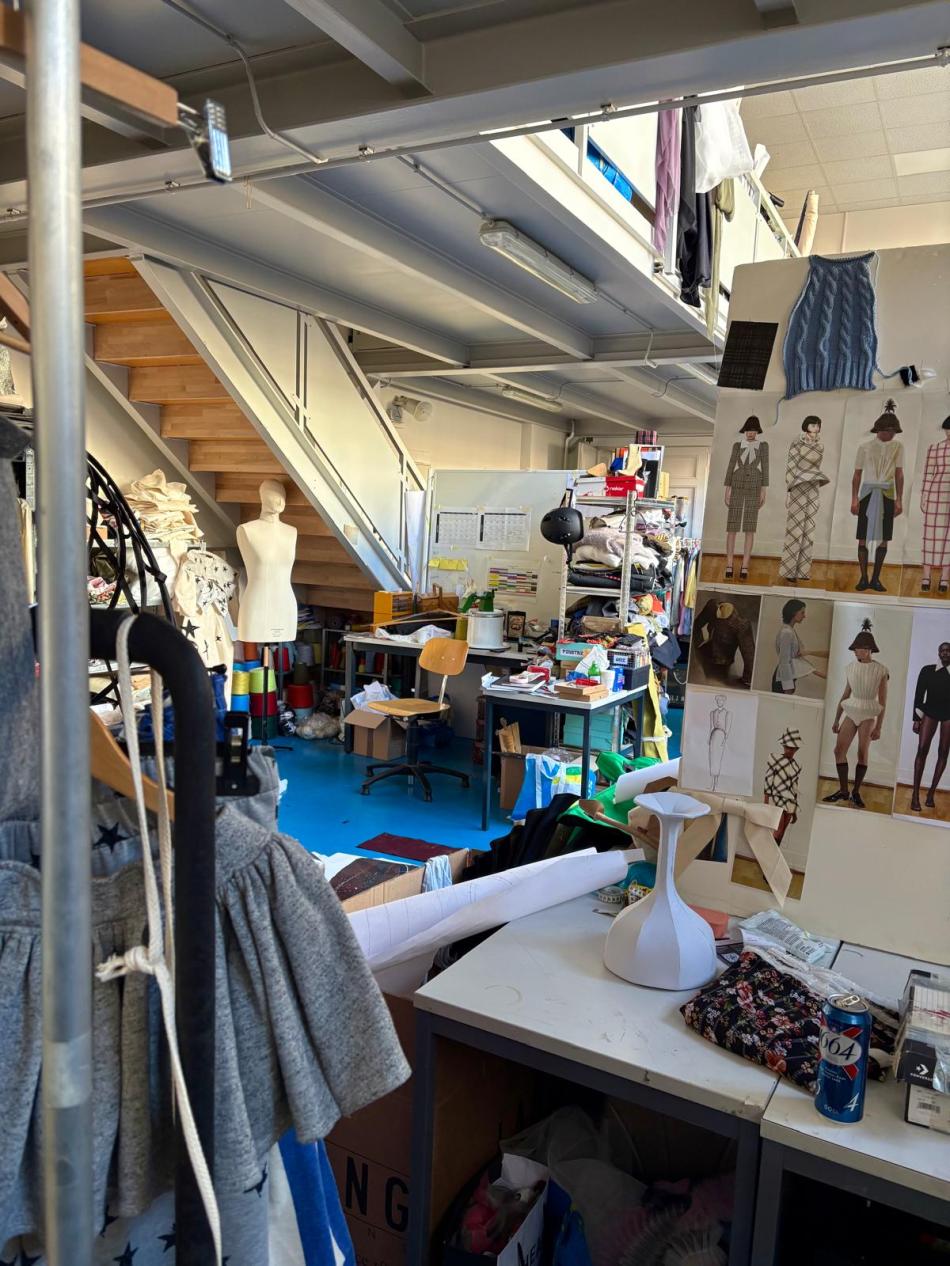
Their building is flooded with light, organized around a vast and verdant inner courtyard where people gather, to sunbathe, smoke, talk, or share a drink. Every classroom is an atelier: ceramics, jewelry, textiles… These are not just spaces for learning, but for making. Doors are open everywhere. Students move freely between rooms; working, talking, crafting. Even on a weekend, the school is alive.
There are signs of lives in motion: fabrics scattered across tables, tools left mid-process, empty beer bottles hinting at nights where work and pre-drink blur into one another. I could easily imagine someone finishing a project before heading out on a Friday night. Here, creative practice seems inseparable from social life.
At the institute, the atmosphere is strikingly different. Access is regulated by badges that quietly define who belongs where. The walls are bare, the buildings feel colder and metallic. There are few informal spaces to sit, to linger outside of structured purpose. Visual expression from students is scarce and color is rare. The FAB stands out as one of the few lively spaces, which, rather than compensating, only highlights the sobriety of the rest of the institute.
This contrast extends to how students present themselves. Students of the art school appear to be less formal: layered clothing, bold colors, distinctive hairstyles, jewelry, accessories. Style becomes a language of its own, marked by originality, self-expression, non-conformity , and creativity. There is also a visible rejection of heteronormative and cisgender norms, with aesthetics that are fluid and androgynous.
At the institute, there is an implicit dress code. Not necessarily a reflection of individual personalities, but a shared understanding: business-casual. Sophisticated, professional. It projects seriousness, diplomacy, and global awareness. Somehow echoing the formal rigor of international organizations.
At the Institute, we are trained to articulate, to analyze, to position ourselves within global narratives. Our language is one of reports, negotiations, frameworks. Their expression takes another form: visual, material, often more abstract. Statements are not written, instead they are worn, built, performed.
And yet, beneath these differences, we belong to the same generation. In many ways, we are trying to say the same things. We share the same concerns, such as the rise of fascism, the climate crisis, ongoing conflicts, and the uncertain role of youth in shaping « the future ». And ironically, both groups face similarly precarious job prospects, despite the stark differences in how we are trained to navigate the world.
These differences do not only appear in classrooms or on campus they extend into student life itself, shaping lifestyles, social circles, and ways of inhabiting the city.
What follows is only my perspective, one among many, and not an attempt to reduce everyone to the same experience.
I grew up not far from Geneva, and it was quite easy to be back here: old friends, familiar habits, a sense of continuity. I moved into a student housing cooperative that offers not just a place to live, but a form of collective life. My roommates are deeply rooted in different facets of Geneva from its nightlife, activism, and long-standing local networks. Through them, I rediscovered the city, and began to uncover some of its hidden layers.
Then university started. And I quickly observed a different side of Geneva. The institute also operates as a world of its own. Student life often revolves around a few spaces: Picciotto, Perle du Lac, Mr. Pickwick Pub, or Grand Morillon. Of course, this is absolutely not exclusive, but it reveals a certain pattern.
Another layer of separation lies in language. Although the institute presents itself as bilingual, the reality feels more limited. Only a handful of professors still teach in French, and despite the availability of language courses, I remain uncertain about their broader impact on students’ integration into the local, French-speaking environment of Geneva.
This growing sense of contrast became particularly tangible during those two days at the art school. And this contrast reflects something larger about Geneva itself.
Geneva is a city of layers. On the surface, it appears polished, international, diplomatic, a hub of global governance and quiet power. But beneath that lies something less accessible: a more vibrant, experimental, and underground culture that does not reveal itself easily.
People often say Geneva is boring. It isn’t. What makes the city feel closed is not a lack of things to do within it, but the difficulty of entering its circles. The most dynamic spaces are often hidden, coded, or socially gated. You don’t simply stumble into them: you are introduced, invited, or slowly initiated.
In that sense, the divide between the two schools mirrors the city itself. One is closer to the visible, institutional Geneva; the other operates nearer to its creative underground. And yet both coexist, often without truly meeting.
Perhaps the challenge is not only to acknowledge these parallel worlds, but in creating ways to make them intersect beyond occasional workshops.. Because somewhere between policy papers and protest banners, between analysis and creation, there may exist a more complete way of being engaged as young people.


0 comments on “Geneva’s Invisible Divide”