
by Sabrina Casale
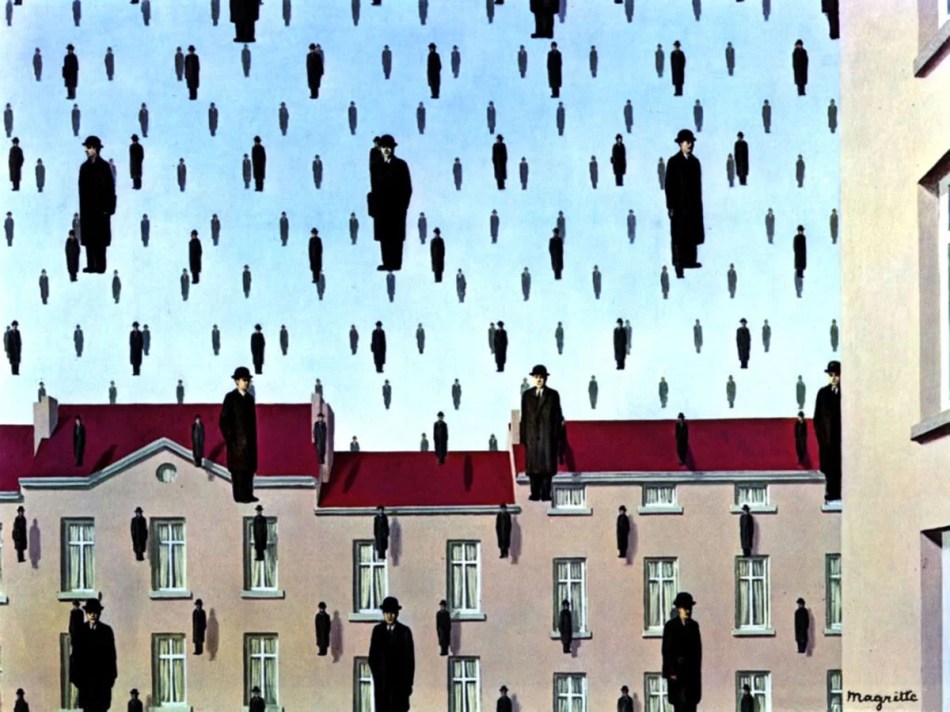
Golconda by René Magritte is a surrealist composition painted in 1953. Despite taking its name from a city in Hyderabad, India, the painting is less about geography than about social meaning. Magritte presents a sky filled with nearly identical men: same posture, same clothing, no interaction. They appear suspended and uniform but, at the same time, isolated from each other.
Seventy years later, this image feels less surreal than it should. It echoes something increasingly visible in Western European societies: an environment shaped by polarization and uniformity.
Social media appears to amplify this dynamic. Especially within Gen Z, it is quite widely known that algorithms shape how we perceive the world. What is probably less known is that this feature is in the very basic functions of social media: posting, reposting, and following encourages the formation of like-minded networks, often described as “echo chambers”. These networks are comforting bubbles, where uncomfortable debate becomes impossible and unwanted. While this is often discussed, even in political contexts, proving this effect empirically has been difficult. As all experiments involving social media, paying a high number of users to participate becomes extremely costly. However, recent experiments in computational social science offer an interesting perspective.
Researchers at the University of Amsterdam simulated a social media platform using users generated with AI. These virtual individuals interacted by choosing news, posting, reposting, and following others based on their assigned preferences. Over thousands of interactions, the same pattern consistently emerged: echo chambers were formed, influence became concentrated among a few voices, and extreme opinions gained high visibility.
As the researchers have emphasized to Science.org, this outcome did not require complex manipulation. It arose naturally: only a few inputs were given, and, immediately, extremists about the topic would appear on the users’ feed. In other words, polarization is not just a product of human intention: it is in the structure of those systems we normally use to communicate.
However, looking around and beyond social media, we can observe how this polarization can be observed also in other areas of daily life, especially in politics.
In 2024, scholars Acampa and Nunziata, from the University Federico II in Naples, examined right-wing populist leaders across Western Europe, focusing on what they described as “pernicious polarization”. Their findings suggest that political discourse is shifting away from ideology and toward emotional appeal. The issue is not simply disagreement, but the growing inability, or more sort of unwillingness, of opposing groups to engage with one another. That is how, in the current landscape, the middle ground started to disappear leading to decreasing political, moderated, debates between left and right wing, center-oriented movements, or daily conversations within opposing parties.
These extremist tendencies expand beyond political ideas and into personal identity. A telling example is Silvia Salis, the left-wing mayor of Genova in Italy, framed by international newspapers such as Bloomberg as a potential rival to Giorgia Meloni in the next elections. Interestingly, criticism directed at Salis does not focus solely on her political ideas, but also on her appearance: her clothing, her accessories, her perceived lifestyle. She is judged for not impersonating the traditional left-wing woman, not fitting into what people expect her political ideology to represent. At the same time, she embodies traits often associated with her right-wing opponents: she is a Catholic white woman and she has children.
In my opinion, this contradiction reveals something deeper. Political identity is no longer just about beliefs: it has become aesthetic, almost a performative identity. People are expected to fit into recognizable categories, and when they do not, social discomfort emerges. Labels are not ideological anymore, they are now visual and cultural.
According to the SoDA Report 2020, “digital sameness” has even become a defining trend in technology in the last few years. Websites, apps, and online platforms increasingly resemble one another, following the same layouts, aesthetics, and user experiences. In fact, not looking at the logo, it is often difficult to even distinguish one brand from another.
Unfortunately, this uniformity is not limited to digital spaces. Physical environments, particularly in urban settings, seem to mirror this convergence. As many have surely noticed, cafés, for instance, often share the same visual identity: bright interiors, minimalist furniture, neutral colors.
A 2024 article in The Guardian captures this phenomenon, asking the question: “why are coffee shops all the same?”. What we often think of as a unique, “authentic” café experience has, in reality, become highly standardized. Independent cafés across different cities, despite having no direct connection, tend to adopt the same aesthetic: natural light, wooden tables, specialty coffee, and familiar menu items like avocado toast or matcha. While these spaces are not copies of a single brand or a chain, they still result from a shared visual aesthetic shaped by social media. Their “authenticity” does not come from local tradition or seasonality, but from their alignment with an algorithmically influenced taste.
To me, this raises a paradox. Western societies seem increasingly obsessed with authenticity: seeking what is unique, local, and different. Travel trends reflect this desire, as many people look beyond Europe to regions perceived as less standardized, such as Southeast Asia. Yet, this search seems to contribute to the very homogenization it tries to escape. As widely discussed in the last years, mass tourism can lead to gentrification, reshaping local cultures to meet some specific external expectations.
So the question becomes unavoidable: is it fair? Is it fair to look for authenticity while simultaneously carrying uniform standards within us? Are we truly looking for difference or do we just accept those few variations that fit within our mentality?
Perhaps Magritte’s vision was exaggerated. Certainly we are not identical figures suspended in space and not speaking to each other (not yet at least). Yet, we are increasingly easy to categorize on the basis of our tastes, our appearances, our algorithms and our political affiliations. Increasingly, we are more and more asked to be coherent: to align one’s lifestyle, aesthetics, and beliefs into a consistent, recognizable identity, as the debate around Mayor Salis made clear.
At the same time, there is an equally strong impulse to oppose, to define oneself against another group. This leads us to wanting to be part of the good side, pointing the finger at the opposite side. This tension, between uniformity within groups and polarization between them, may be one of the defining features of contemporary Western societies.
Whether this trajectory will intensify or eventually correct itself, I do not know. However, what is clear to me is that these patterns are not emerging in isolation. They are shaped by the technologies we use, the environments we inhabit, and the cultural frameworks we reproduce. So, are we shaping the future or is the algorithm doing it for us? The answer likely lies somewhere in between. But if we are not really careful, we may find ourselves getting closer to Magritte’s silent figures than we would like to admit.


0 comments on “Inside the Echo Chamber: Are We Still the Ones Shaping Our Future?”