
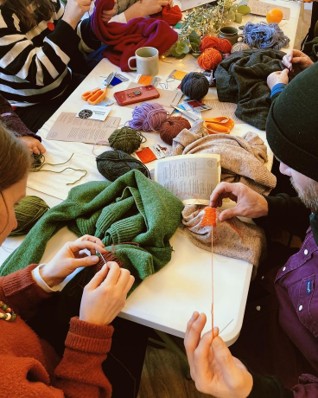
Picture: Knitting Party in London. Copyright : Instagram/ @finisterre
By Gregory Wagner
Why Gen Z is trading screens for yarn, binoculars and jigsaw puzzles — and what it says about us
Crocheting a Sophie Scarf, solving jigsaw puzzles in the library or birdwatching in the Jardin Botanique. Hobbies that were once considered the pastime of our grandmothers and grandfathers are now very much back en vogue among our generational cohort, the Gen Z.
Enter the knitting circle
On university campuses and beyond, something is quietly blossoming between lectures and late nights. Students knit in between study sessions, press flowers between the pages of their notebooks, solve crosswords and go visit pottery classes. The hashtag #knittok has more than 1 billion views on TikTok. Sales figures for jigsaw puzzles have almost doubled in the years following the pandemic. Birdwatching, long the butt of every joke about pensioners, is seeing its fastest growth among under-30-year-olds. And of the 68 New York Times crossword constructors who have made their debuts as teenagers, almost half have been from the Gen Z.
Whatever you call it, be it grannycore, cottagecore or simply a shift in mood, the trend goes far beyond those terms. For many young people, it represents a genuine reorientation of their leisure activities.
At first glance, the reasons for it are not hard to find. Nights out are expensive. The cost-of living crisis is biting. And a full day of lectures and studying followed by hours of doomscrolling can easily leave you exhausted. Online, the voices explaining the switch to slower hobbies are remarkably consistent. “My brain finally goes quiet,” is a phrase that appears repeatedly. “At the end of the week I have a thing I can hold “, “I can put it on my wall” or “It doesn’t need charging”. The hunger being described is not simply for relaxation. According to the Guardian, slow hobbies offer a counterweight, they are affordable, screen free and require physical skills.
Your brain on crochet
Research supports what young people are explaining online. A 2024 study published in Frontiers in Public Health analysed data from over 7,000 adults and found that engaging in arts and crafts significantly predicted increased life satisfaction and higher levels of happiness. The most striking finding was the scale of the effect: the impact of crafting on participants’ sense that their life was worthwhile was bigger than the impact of being in employment. “Not only does crafting give us a sense of achievement,” study director, Dr. Keyes, observed, “it is also a meaningful route to self-expression. This is not always the case with employment.”
The neurological picture is equally compelling. Repetitive craft activities trigger the release of serotonin, dopamine and oxytocin, the same reward activated by meditation or other physical activities. An American study found that people who knit, quilt or read regularly report between 30 and 50 percent fewer cognitive difficulties, with researchers suggesting that such activities actively strengthen neural connections in the brain. And unlike a phone-based puzzle app, a physical object offers something screens structurally cannot: visible, cumulative evidence that you did something. You can hold it. You can give it away. It was real before you picked it up and it remains real after you put it down.
Psychologists have a word for the deeper pull these hobbies exert. Anemoia describes the nostalgia one feels for a time never actually lived through. A longing, in an era of flashy screens and endless apps, for the satisfying simplicity of making something with your hands. The Economist has noted the phenomenon with a certain wryness and commented that younger people are now looking with genuine fondness at such reliably unglamorous activities as darning a pair of old socks.
Beyond nostalgia
But to call this nostalgia is to underestimate it. A Pew Research survey in 2024 found that almost half of American teenagers now view social media’s effects as mostly negative and 44% have cut back their social media use. People who start crocheting or head to the park with binoculars are not simply yearning for their grandparents’ world. It is more an active, considered choice about how to spend your leisure time. In an age when artificial intelligence
can produce an image, a song or an essay in seconds, making something slowly and imperfectly by hand suddenly can feel like a rebellious act. The uneven stitch, the jigsaw piece found after twenty minutes of searching, these are not failures. Rather they are increasingly the point.
Against the backdrop of a well-documented youth mental health crisis, these slow hobbies are more than a passing aesthetic or a quirky counterculture. They are a response to an attention economy that has consistently demanded that young people produce, consume, scroll and perform and has offered very little stillness in return. The knitting club, the puzzle on the library table, the birdwatching in the Jardin Botanique: none of these are a retreat from modern life. They are a negotiation with it, conducted one careful stitch, one turned page, one spotted bird at a time.
So next time you’re feeling stressed, instead of doomscrolling on your phone, why not start with a Sophie Scarf or meet at the Jigsaw Puzzle in the library? Not only will it help you relax, but it will also bring joy to the lucky participant.


0 comments on “Grandma is always right: Slow Hobbies Are Back”