
Péter Magyar Election in Hungary
By Paolo Tarony Saisi de Chateauneuf
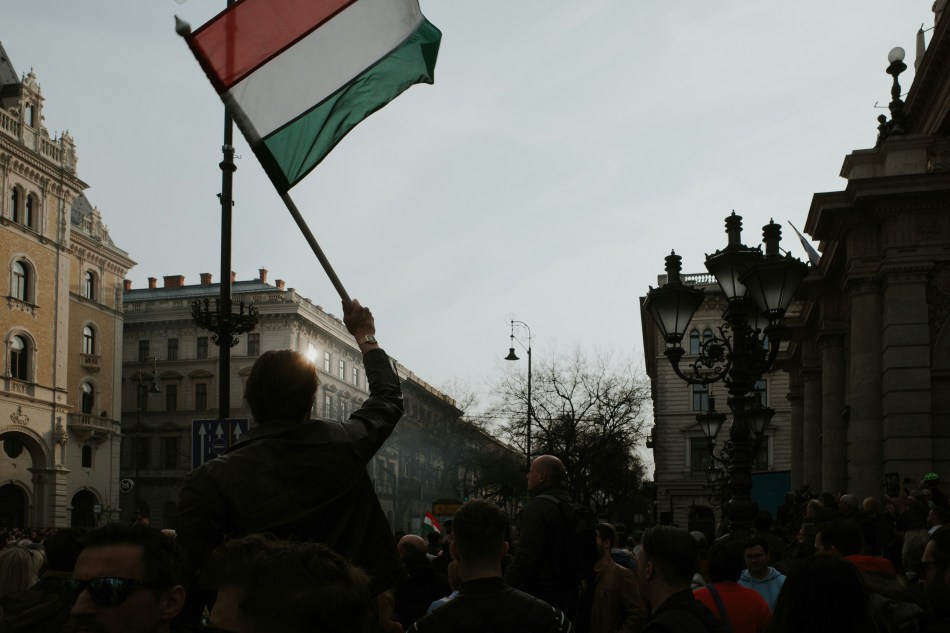
On the night of April 12th, on the banks of the Danube, Péter Magyar stood anxiously before an ecstatic crowd that had been craving radical change in the Hungarian political system for longer than many of them cared to admit. Then the ballot results came in. After sixteen years of Viktor Orbán, the Tisza Party had won a supermajority in the parliamentary election, and Péter Magyar would become Hungary’s next prime minister come May. Following sixteen years of what one might fairly call winter for Hungarian democracy, spring had finally arrived. The streets of Budapest were reborn — people cheered for renewal, wept for it, demanded it. Across Europe, chancelleries and editorial boards rushed to reach for the same word: rebirth for Hungary and potentially for Europe.
Péter Magyar’s rise deserves a closer look. He was a former Fidesz member and Brussels diplomat for roughly a decade. Then in February 2024, Magyar broke with Orbán’s establishment following the Katalin Novák presidential pardon scandal. Novák, then Hungary’s head of state, had discreetly pardoned a man convicted of concealing child sexual abuse at a state-run children’s home. Magyar refused to stay silent. He publicly condemned the government for corruption and declared he wanted no part in a system that had hollowed out Hungary’s democratic foundations. The public responded — his words struck a nerve, and his profile rose sharply as Orbán’s government absorbed the backlash.
However, let’s get one thing straight, winning an election is one thing, governing is another. Magyar and the Tisza Party’s supermajority have moved the needle in Hungarian politics. But context matters. He spent years operating comfortably within the very machine he now condemns, and that history can’t simply be set aside. Like spring itself, his emergence carries the promise of something new, fresh sprouts breaking through the frozen ground of Hungary’s political system. But spring is also unpredictable and sometimes even deceptive. It often arrives with warmth and hope and then retreats, without warning, into one last cold period. Therefore, Magyar’s election might spark renewal, by dismantling corruption, restoring the rule of law, and realigning Hungary with EU standards on checks and balances. However, these promises might face some backlash in Hungary’s “illiberal” political system. In fact, there is a structural problem which could delay Magyar aspirations. Most importantly, he won’t be inheriting a neutral institution waiting to be reformed, instead he’ll be inheriting a political system that was deliberately built to resist exactly the kind of change he’s promising. Viktor Orbán’s sixteen-year reign in Hungary has left Fidesz’s fingerprints on virtually every corner of the Hungarian state, from the courts to the public administration, the media landscape, the business networks.
Concerning his commitment to the European Union, the question remains open, and as Donald Tusk and European analyst Alexander Dubowy put it, European leaders would do well to temper their expectations. Indeed, while Orbán’s defeat could spark a massive boost for the EU, in its fight to regain assertiveness on the international chess board, patience will be required from all sides. This was not, as some have framed it, a clean victory for greater European progressive integration against the far right and its Eurosceptic views. Indeed, Magyar and many of his supporters remain sceptical of the EU’s stance on key topics such as the war in Ukraine, migration and climate change. Therefore, little should be taken for granted. Nevertheless, there are signs of alignment. Péter Magyar has promised to work with the EU and NATO and has critical views on Russia. Consequently, the unblocking of the 90-billion-euro loan to Ukraine, the signing off on a new sanctions package against Russia and deeper European integration could be real and consequential shifts on the horizon. But as Alexander Dubowy cautions, Magyar is best understood as a “younger, more dynamic and more pragmatic Orbán”. Hence, he will seek to be a constructive partner with Brussels, not a disruptor as his predecessor. However, he will defend Hungarian national interests, firmly and with considerable skill. The tone will change.
All in all, the frictions between the EU and Hungary will not disappear, but there is hope for change. For the first time in sixteen years, Budapest and Brussels will share common ground. Magyar will be seeking to unfreeze Hungary’s Eu funds worth 35 billion euros by meeting the Commission’s 27 conditions relating to anticorruption, judicial independence and the rule of law. These are also central promises of the incoming Hungarian prime minister, and he knows that without the EU funds, the domestic reforms he has envisioned will be considerably harder to deliver. Brussels, for its part, has every incentive to meet him halfway: accommodating Hungary’s legitimate interests and strengthening Magyar’s standing at home serves European cohesion and assertiveness on the international scene. Pair this with the setback Moscow has just absorbed, and the EU’s powers are considerably enhanced. For many years, Putin had convinced Orbán to delay decisions within the EU and increase fragmentation in order to hinder Europe’s legitimacy, serving the Kremlin’s interests. Now with Magyar, that instrument might be gone. For the first time in a long while, the EU will no longer fear being held hostage by one of its own members. Nevertheless, we shouldn’t forget that Péter Magyar was the right hand of Viktor Orbán for many years, so it will be interesting to see what will happen in the near future. Just like in spring, change happens, but recoil can happen at any time.


0 comments on “Rebirth for Europe? ”